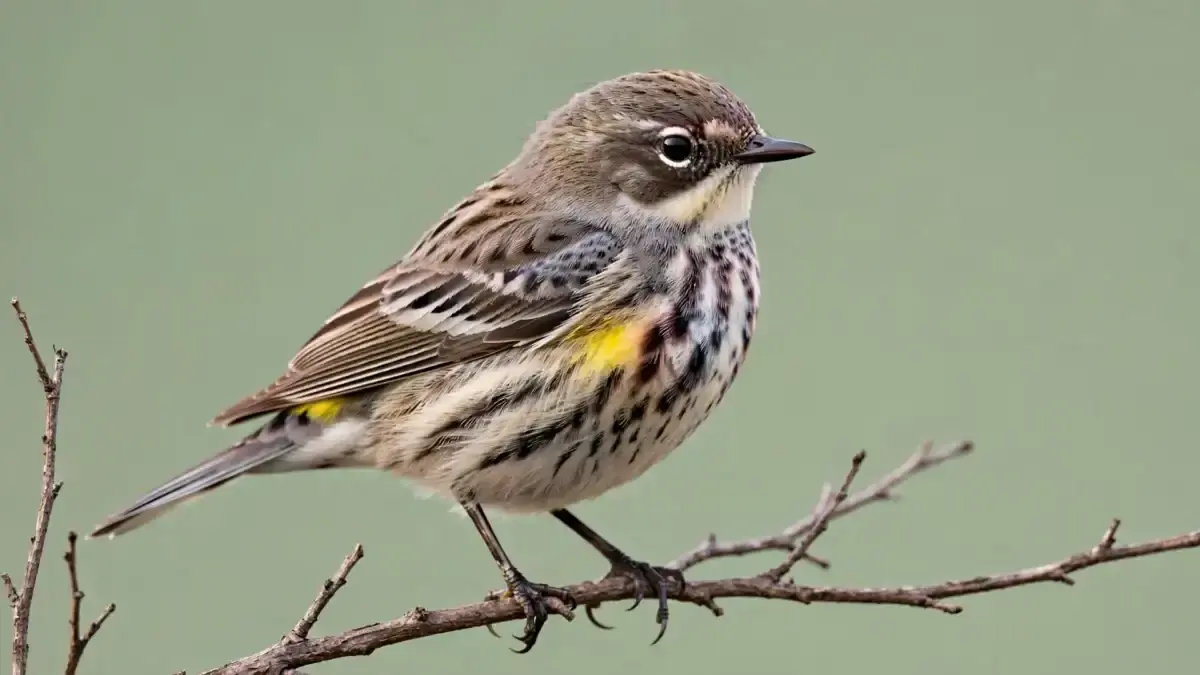
The yellow-rumped warbler is a small bird with streaked brown plumage and a bright yellow rump. It is the most common warbler to see in the USA during the autumn and winter months. Most warblers migrate far further south than this species, however it can be seen overwintering in southern parts of the USA.
This guide will show you how to identify the yellow-rumped warbler in its winter plumage. It will also teach you how to tell apart the myrtle and audubon warbler subspecies, and what they eat (berries!) to survive the winter.
Look out for their yellow rump and check for the throat and flank patch. Listen for their call to help identify most sightings. These birds can be found in parks, coastal scrub and gardens.
How to Identify a Yellow-Rumped Warbler in Winter
This is a seasonal migrant. In the spring they have a distinct sharp pattern of slate gray, black, white and yellow. However, in the autumn and winter they become duller with pale brown backs and streaked underparts. This means that you will need to look closely at a couple of features to be able to identify this yellow rumped warbler during the winter.
The four marks that matter most
- Yellow rump: The bright patch just above the tail, often clearest when the bird flies away.
- Yellow side patch: A smaller yellow patch on the side of the chest, fainter in winter but usually still present.
- White tail spots: White spots in the tail, useful at a distance when feather detail is hard to see.
- Streaked, full bodied shape: Fairly large for a warbler, about sparrow sized at 5 to 6 inches, with a large head, a sturdy bill, and a long, narrow tail.
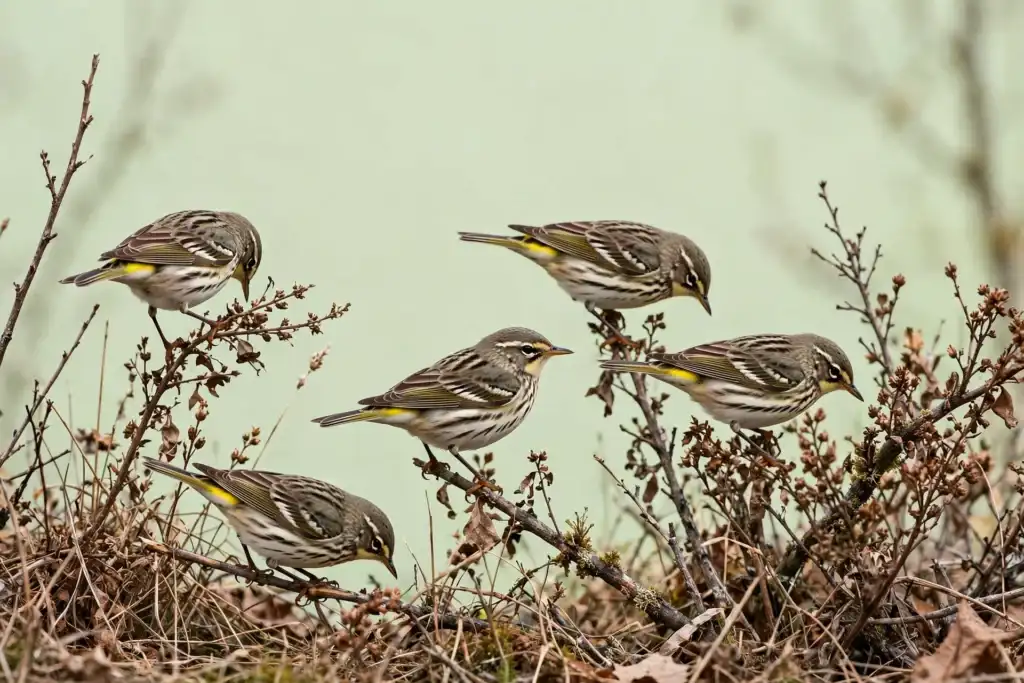
Another clue is their behavior. Yellow-rumped warblers will often forage in small flocks in the winter. They can be seen darting around low bushes and trees feeding on berries and insects. These are very active birds and will often fly off to catch some insects. An example would be a very active bird darting around from branch to branch with a high ‘chip’ call and flashes of bright yellow.
What winter plumage looks like, in plain terms
Overall a brown/gray/yellow bird. The upperparts are grayish brown with streaking. The underparts are streaked with a pale center. There may be a small amount of yellow on the crown, but this can be difficult to see in winter.
Female and juvenile are generally paler than males. In particular females will be the most drab during the autumn and winter months. Not all females will match the males in your field guide during the winter. Look for a combination of features.
They have a yellow rump, yellow patch on the flank (if present), white spots on the tail feathers, streaking, size and behavior. If three or more of these match then you can be confident that they are the right bird.
Myrtle Warbler vs Audubon Warbler: Which Form Are You Seeing?
Generally there are two subspecies of yellow-rumped warblers in the US. These are the myrtle warbler and audubon warbler. They were once separate species but are still very different and many birders will learn them as two subspecies. Most people will just want to know what they are likely to see.
The Myrtle subspecies breeds throughout eastern and northern North America. This is the subspecies most likely to be seen by birders in the eastern regions of the USA. The Audubon subspecies breeds throughout western North America, including mountain coniferous forests. This is the subspecies most likely to be seen by birders in the western regions.
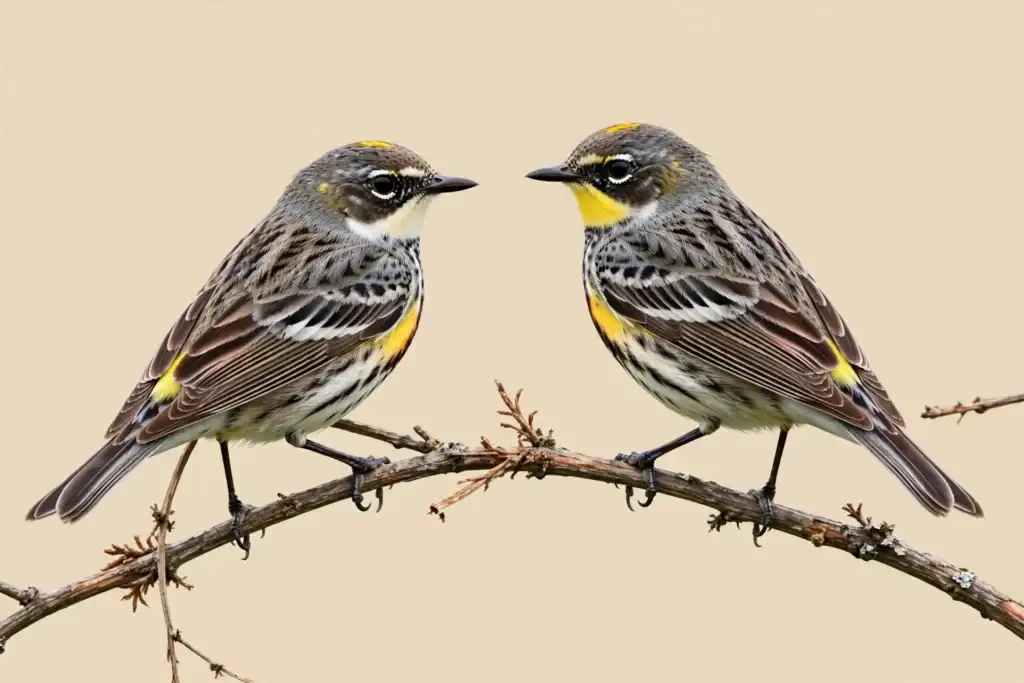
The most obvious feature to distinguish adults is their throat colors. This can be an advantage in winter months. However, females and juveniles may not be quite as vibrant. Myrtle warblers have white throats while audubons have yellow throats.
Myrtles have a very distinctive dark patch on their cheeks with a white collar. Audubons have more of a plain face. Males tend to have more white on their wings than males. Females have less distinctive faces and may not have a dark patch on their ears like myrtles.
| Feature | Myrtle warbler | Audubon warbler |
|---|---|---|
| Usual region in the US | Eastern US | Western US |
| Throat | White, sometimes dull buff in some young birds | Yellow |
| Face | Dark cheek patch, well defined, with white behind it | Plainer face, less contrast |
| Wing | Two wing bars, less extensive white | More extensive white in the wing |
| Yellow rump and side patch | Present in both forms | Present in both forms |
A careful note about region and form
Not all areas will have both types. The Audubon form is a very rare migrant in the east. The Myrtle form can be found in streamside trees in the coastal areas of the Pacific states.
In general, you will find Myrtle types in the East, and Audubon types in the West. However, birds in the middle of the country will need to be taken a look at to determine which type they are.
If the bird you are looking at does not fit into any of these categories, please make a note of what you have seen. Include details such as throat color, facial markings, wing markings and location. The more information you can provide the better. It can be difficult to identify throat color in winter due to the lighting.
Why Yellow-Rumped Warblers Can Stay for Winter
Most warblers will migrate out of the US in the autumn due to a lack of insects to eat. However, yellow rumped warblers do not fit this pattern:
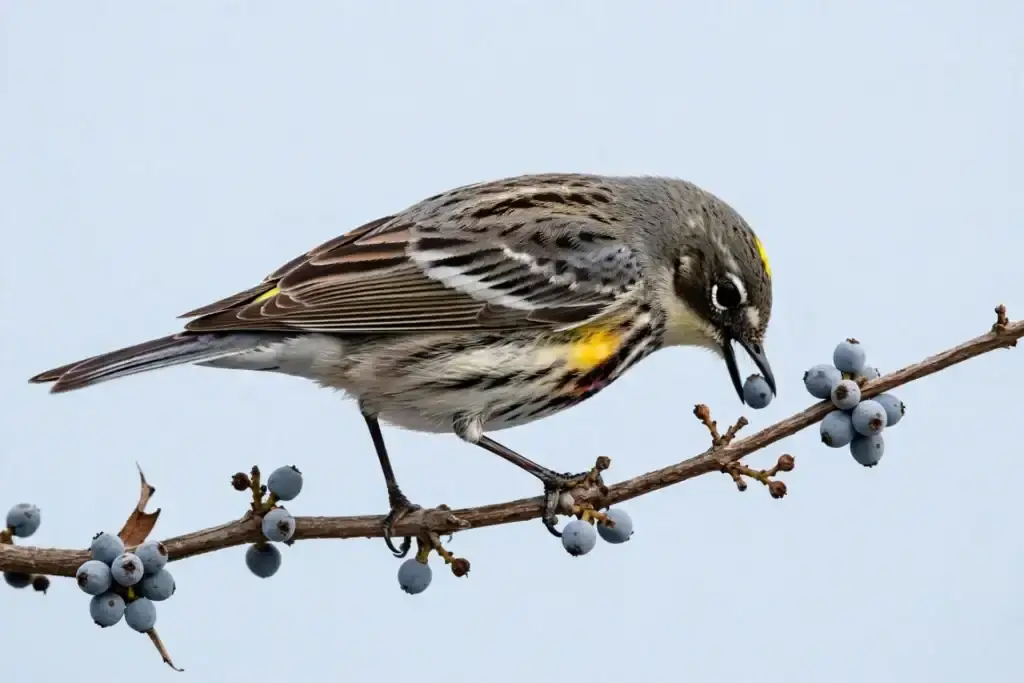
They are insectivores and will eat a wide variety of small animals including caterpillars, wasps, grasshoppers, gnats, aphids, beetles and spiders. They will often glean insects from leaves and twigs, hover to catch insects in the foliage and fly to catch insects. During the autumn and winter months they will still eat insects when they can but will also eat large amounts of berries.
The berries are mostly waxy. Audubon mentions that they will eat bayberry, juniper, wax myrtle and poison ivy during winter. The Cornell Lab states they will also eat more bayberry and wax myrtle.
They can also eat the berries because they can digest the waxy coating. This is a main reason why they can migrate further north than most warblers in the winter.
They can migrate south if it is very cold, there is no growth of berries or if there is a long period of bad weather. They can also migrate south in the winter when their berries run out.
While they may not be stationary during the winter months, having berries means that they can be found in the southern parts of the US. There is a large number but some can also be found as far north as New England and the Seattle area (Audubon).
Where Yellow-Rumped Warblers Spend Winter in the US
They have a very large range during their winter months across the United States but are most commonly found in the southern regions including the Southeast, Gulf Coast, Texas and southern Atlantic Coast. They can also be found along the Pacific Coast and parts of the Southwest.
They have a large winter range in much of the central and southeast areas of the country (Cornell Lab). They are often seen as far north as New England and Seattle (Audubon). However, they are not as common in this area and will depend on the availability of food and shelter.
These birds can be found in a variety of habitats during the winter months, including open woods, scrub, thickets, gardens, parks, urban areas and even beaches. In the east they are often found in bayberry thickets along the coast. In the west they depend on riparian woods. Both areas will have good areas of scrub, woodland edges and areas of fruiting shrubs.
They can be found in conifer and mixed woodland during their breeding season. They are usually in more open areas of woodland and woodland edges. Pine, fir, spruce and aspen woodland. In the west they can be found in high mountain conifer woodland. However, this will depend on the area they are in, as the number of them can vary from year to year depending on the weather and if there are plenty of berries.
How to Find Yellow-Rumped Warblers in Winter
Yellow-rumped warblers can be one of the easiest warblers to find in winter as they are common, active and will readily use open and accessible areas. However, they can be difficult to identify within mixed flocks and poor winter light.
Start with habitat, then listen, then look
- Check fruiting shrubs first: Walk shrubby edges slowly and scan berry bearing shrubs, especially bayberry, wax myrtle, and juniper where they grow in your area.
- Listen for the sharp chip: The yellow-rumped warbler call is often described as a sharp check or chip note, given frequently while foraging and in flight.
- Watch for movement and flashes: Look for small birds flicking between branches and flashing yellow rumps as they move away.
- Scan whole flocks: Winter birds often feed with chickadees, titmice, and kinglets, so check the flock branch by branch.
- Use good light: Morning light, or light from behind you, makes throat color and yellow patches easier to judge.
Check the rump, throat and flank patch. If the throat is white then it is most likely to be a myrtle warbler. If the throat is yellow then it is most likely to be an audubon warbler.
In terms of general timing, this guide to the best times of day to see birds will explain why mornings are often a great time to see birds. In terms of migration timing, this guide to when birds migrate in spring and autumn explains that yellow-rumped warblers tend to migrate earlier in spring and later in autumn than many other warbler species. This means they tend to stay later in autumn compared to other warblers.
What to Offer, and What to Leave Alone, in a Winter Yard
Yellow-rumped warblers are sometimes attracted to your backyard during the winter months. You can attract them by offering them sunflower seeds, raisins, suet and peanut butter (Cornell Lab backyard tips). To attract them most effectively you should also have a backyard that offers them shelter, water and natural food sources.
Planting native shrubs that bear fruit is the best way to attract them long-term. Wax myrtle and bayberry can be planted in coastal and southern gardens. Juniper can be planted in other areas. Other native shrubs that produce berries can be used. Ensure you plant shrubs native to your area and soil type. Let them produce fruit naturally and don’t prune the berries in autumn. Planting a multi-layered shrubbery with some gaps and a few tall trees will provide them with shelter, food and protection from predators.
In general, the guide on attracting birds to your backyard will give you some tips on feeding, water and shelter. The guide on feeding birds in winter will give you specific tips on what to put in your feeders. If you want a long-term project, the guide on creating a bird friendly garden will show you how to use native plants to create a habitat with shelter and water.
Do not plant poison ivy. Even though they will eat the berries, it is dangerous to humans. Do not encourage them to grow or plant it. Do not try to flush them out or chase them. They are using a lot of energy to stay warm in the winter. Give them space, move slowly and let them feed.
Similar Warblers and Common Identification Mistakes
Warblers can be difficult to identify in winter when many species are relatively drab and brown. However, the yellow rump makes this species easier to identify. No other common warbler in the USA has a yellow rump, yellow flank patch and streaky winter plumage. Confusion can occur, especially in poor lighting or when the flock is moving quickly.
| Bird | How it differs from a yellow-rumped warbler |
|---|---|
| Palm warbler | Often pumps its tail and lacks the bright yellow rump patch as a clean, separate mark. |
| Pine warbler | Plainer, often in pines, with no bright yellow rump patch. |
| Orange-crowned warbler | Dull olive yellow overall, with no yellow rump or yellow side patch. |
| Black-throated gray warbler | In the West, has a black throat and a black and white face pattern, and lacks the yellow rump. |
Common errors are to assume based on a single blurred image, to call all streaky winter warblers yellow-rumped warblers on streaking alone, and to force a particular form if the throat is not clear. If unsure, it is better to note the bird as uncertain form than to guess from range alone.
Frequently Asked Questions
Are yellow-rumped warblers the only warblers that stay in the US in winter?
No, they are the main warbler species in North America during winter. There are a few others found in the US. Pine warblers are found across the southeast in small numbers. Some orange crowned and Townsend’s warblers are also found in parts of the west and south, in small numbers too.
What is the yellow-rumped warbler call in winter?
Listen for the ringing ‘check’/’chip’ call given while feeding and flying. The loose buzzy warble is mainly heard in spring; it may not be possible to hear any full songs in December and January. The ‘check’ call will help you find winter flocks.
Do yellow-rumped warblers eat berries all winter?
Berries are an important food source for them during the fall and winter months. But they will also eat insects when they become available. On warm winter days they can be seen feeding on insects. Some yards will even have feeders with suet, sunflower seeds, raisins and peanut butter.
Where is the best place to see a yellow-rumped warbler in winter?
Shrub borders, seaside thickets, parks and gardens, especially with bayberry, wax myrtle, juniper or similar fruiting shrubs in the south of the USA. Coastal areas will be productive in the East. Woodland and shrubbery parks along streams will be good in the West.
Will a yellow-rumped warbler visit my feeder?
If you put out suet, sunflower seeds, raisins and/or peanut butter along with some shrubs and cover in your yard, they may visit. They are not as regular as chickadees or finches so if they come and go quickly don’t worry. Often natural berry bushes will be more important than a feeder.
How do I tell a myrtle warbler from an audubon warbler in winter?
Look at the color of the throat. White = Myrtle, Yellow = Audubon. Look at the face. Myrtle will usually have a distinctive marking on their cheeks which will be darker. Audubon will be more plain. Females and juveniles will be duller. Audubon is very rare in the East so looking at the range can help you identify. However, this is not as good as seeing the bird itself.
Do yellow-rumped warblers migrate at night?
Like many songbirds they are nocturnal migrants but can also be found feeding during the day. This article will focus on their behavior in winter. They are frequently seen in large numbers along the Eastern Seaboard as there are plenty of wax myrtles for them to feed on while migrating.
Conclusion
These birds certainly live up to their name! They have a bright yellow rump that flashes when they take off, yellow sides, a sharp chip and will eat waxy berries.
Knowing the differences between the white throated myrtle warbler (eastern) and the yellow throated audubon warbler (western) will help you to identify this bird with confidence. Knowing where to find berries will help you to get the most out of your birding in winter.
When you next venture out in the cold, look for these birds in the shrubs! Listen for their chipping sounds and look for any movement. Don’t rush them – take your time and enjoy watching them eat the berries. These birds aren’t rare, so you should be able to see them quite regularly in winter.
Sources and Further Reading
The facts in this guide were checked against these authoritative sources: