
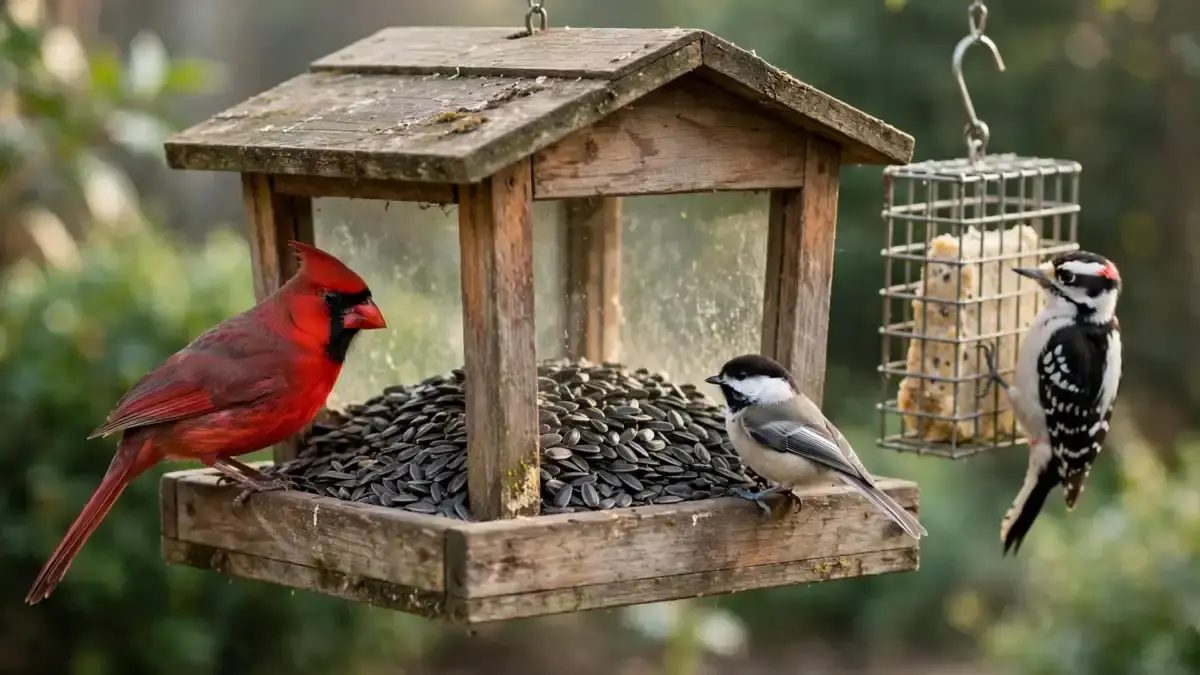
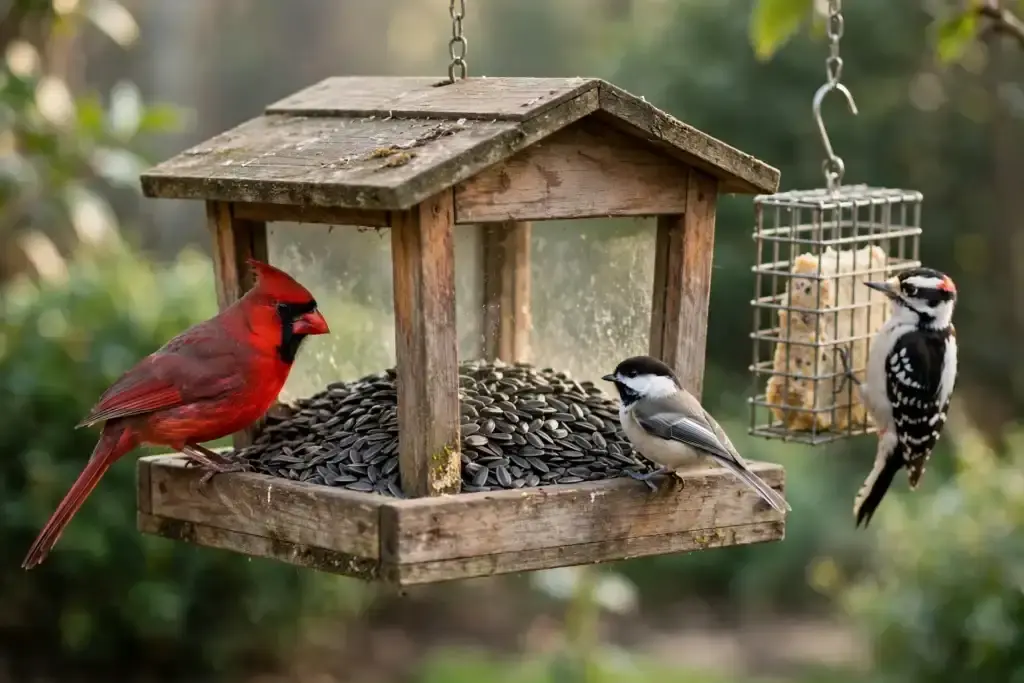
A feeder can turn your garden into a daily bird-watching spectacle. Within days of putting up your feeders, you may see chickadees zipping around to grab a seed, cardinals showing off with their bright red feathers, and goldfinches crowding a thistle sock in the summer. However, many people struggle to get any birds to their feeders for weeks, or only get sparrows and starlings. This is due to not choosing the right food, feeder or positioning. The reason you will see wild birds at your feeders is because they have learned to eat the food we provide. Each bird has different preferences, eating habits and preferred feeders. This guide will tell you what types of birds you’re most likely to see, what they eat, what feeders to use, where to put them and how to keep them clean, dry and squirrel proof.
What Feeder Birds Are
Feeder birds are any wild birds that visit feeding stations regularly to eat seeds, suet, fruit, nectar, or insects. Over 100 species of feeder birds in North America eat supplementary food to add to their natural diet, according to the National Audubon Society. The most common feeder birds are songbirds, woodpeckers, hummingbirds, doves, and jays.
A great way to get birds close for viewing, feeding birds can help them during cold spells, migration, and nesting season. However, they can be a responsibility. Dirty feeders can cause disease, spilled seed can attract rats, and poorly placed feeders can cause birds to fly into windows.
Birds will often find feeders using their eyesight and by observing other birds. It can take between two to four weeks to establish a regular flow of birds. To understand what birds eat besides seeds, read our guide to bird food.
The Most Common Feeder Birds in North America
Depending on where you are, the birds you will see will vary. However, there are a few key species that will be seen throughout most of North America.
Northern Cardinal
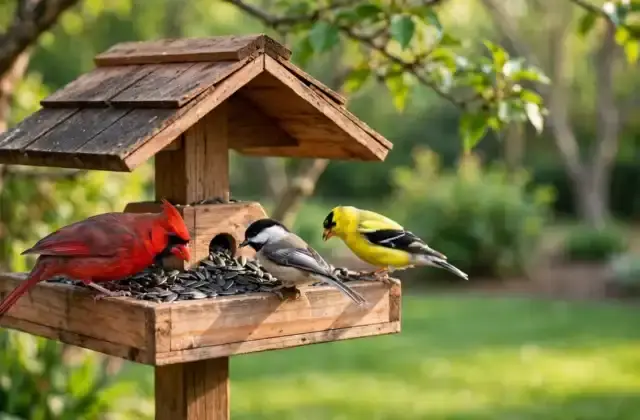
The male northern cardinal has bright red plumage with a black mask and crest. The female is a warm tan color with red highlights. Cardinals are resident in the east and central areas and can be seen feeding on black oil sunflower seeds, safflower seeds, cracked corn, and peanuts from hopper and platform feeders.
Black-Capped Chickadee and Carolina Chickadee
Chickadees are small, bold birds with a black cap and bib, white cheeks, and a gray back. Black-capped chickadees live in the north, and Carolina chickadees live in the southeast. They eat black oil sunflower seeds, peanuts, and suet, one seed at a time.
Tufted Titmouse
The tufted titmouse is a soft gray color with a crest, a black forehead, and rusty flanks. It can be found all year round in the eastern United States, and it feeds on black oil sunflower seeds, peanuts, and suet from tube and hopper feeders.
American Goldfinch
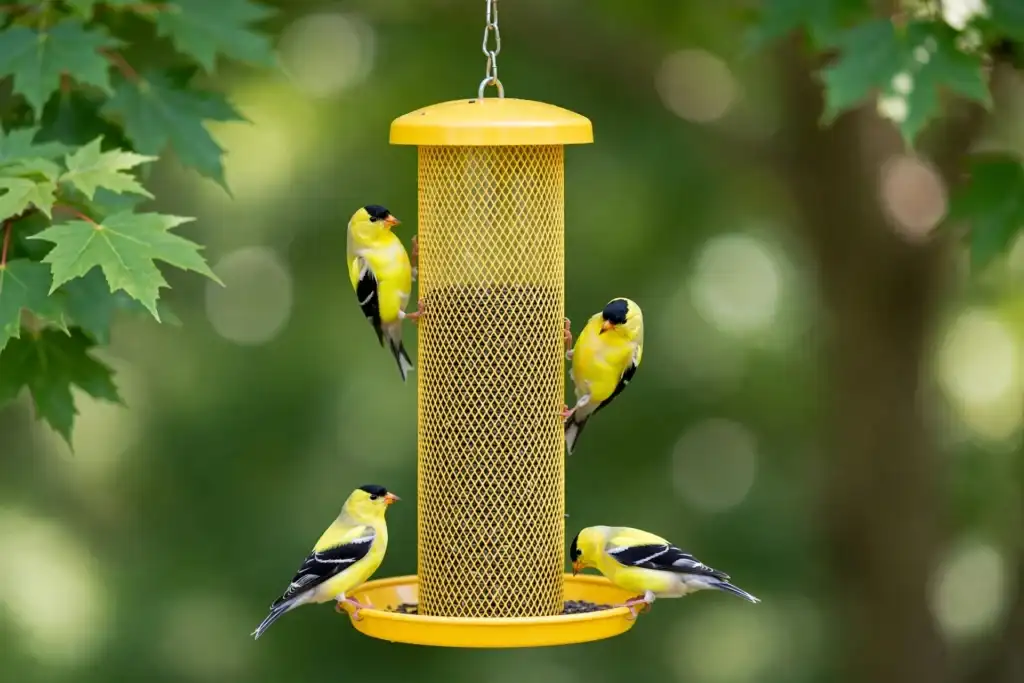
The male American goldfinch is bright yellow in summer, with a black cap and black wings. Both males and females turn dull olive brown in winter. They will feed on nyjer, black oil sunflower seeds, and sunflower hearts from thistle feeders. For more information on what goldfinches eat, please read our guide here: https://birdsbuzz.com/what-do-goldfinches-eat/
House Finch and Purple Finch
House finches are common throughout the country. Males have a rosy red head and breast. The females are streaked brown. Purple finches are raspberry red on their head, back, and breast. Both species will feed on black oil sunflower seeds, nyjer, and millet from tube and hopper feeders.
Downy Woodpecker and Hairy Woodpecker
The downy woodpecker is the smallest woodpecker in North America. It is black and white with a short bill. It looks very similar to the hairy woodpecker, which is larger with a longer bill. Both will eat suet, peanuts, and black oil sunflower from suet cages and tube feeders.
White-Breasted Nuthatch and Red-Breasted Nuthatch
Nuthatches are able to climb down trees headfirst. The white-breasted nuthatch has a white face and belly, a black cap, and a gray back. The red-breasted nuthatch is smaller and has a rusty belly. Both will eat black oil sunflower, peanuts, and suet.
Blue Jay and Steller’s Jay
Blue jays are large, loud, and bright blue with a crest. These are common throughout the eastern and central regions of the USA. In the west, the Steller’s jay fills the same role. Blue jays will eat peanuts, black oil sunflower, cracked corn, and suet from platform and hopper feeders.
Dark-Eyed Junco
The dark-eyed junco is a small gray and white sparrow. They are often known as snowbirds, as they arrive when it is cold. Juncos breed in the northern regions and migrate south in the winter. They will eat white proso millet, cracked corn, and black oil sunflower from the ground or a low platform feeder.
Mourning Dove
Mourning doves are soft gray-brown birds with long pointed tails and a gentle cooing call. They live year-round throughout most of North America and feed from the ground or a platform feeder on millet, cracked corn, and black oil sunflower.
Ruby-Throated Hummingbird
The ruby-throated hummingbird is the only hummingbird that breeds in the eastern United States. In the west, Anna’s, rufous, and black-chinned hummingbirds will visit feeders. Hummingbirds drink sugar water, one part white sugar to four parts water, boiled briefly and cooled, with no red dye and no honey.
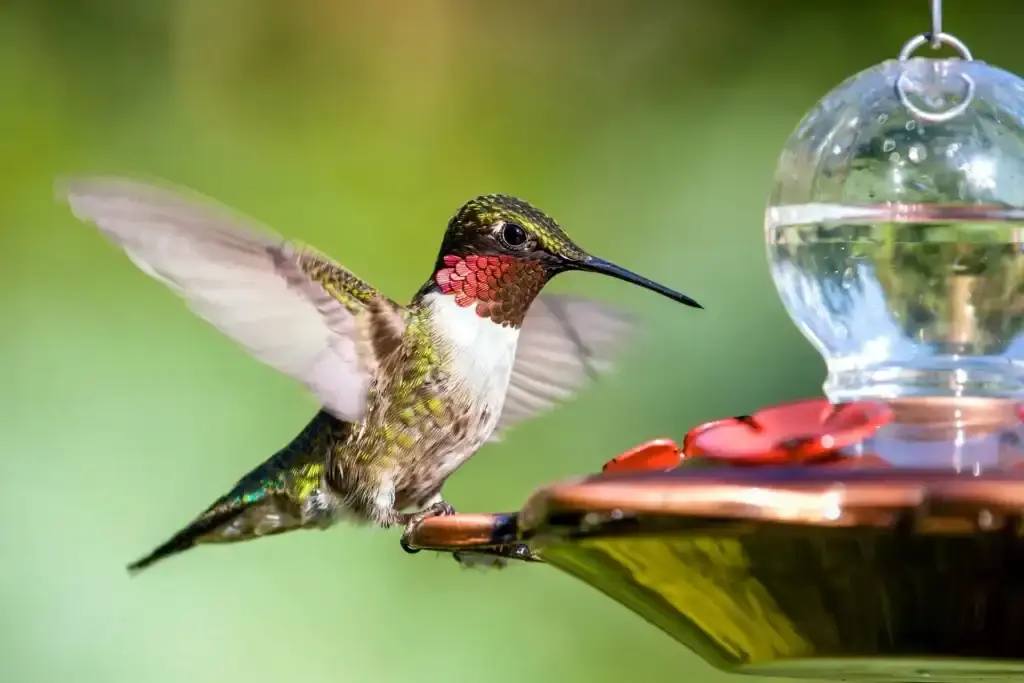
Baltimore Oriole and Bullock’s Oriole
Baltimore orioles (east) and Bullock’s orioles (west) are bright orange and black. They arrive in spring and leave in fall. They eat fruit, nectar, and jelly, so offer orange halves, grape jelly, and a nectar feeder.
Feeder Birds by Region
Depending on where you live, the same feeder can attract very different birds. In the east, you will see cardinals, chickadees, titmice, blue jays, woodpeckers, nuthatches, doves, juncos in winter, and goldfinches year-round, with hummingbirds in spring. In the west, you will also get Steller’s jays, scrub jays, Anna’s hummingbirds, and pygmy nuthatches. Southern feeders run all year, with painted buntings in summer, mockingbirds, and Carolina wrens. Northern feeders in winter bring grosbeaks, redpolls, and pine siskins when northern seed crops fail.
Feeder Birds by Season
As the seasons change, we see migrants return. Orioles, grosbeaks, and hummingbirds all return. Nesting birds will need extra energy, so provide suet, peanuts, and mealworms as well as seed. Summer can be busy with feeders. Goldfinches nest late, so they will be active around thistle feeders, while seed feeders can be slower. Fall can be busy. Migrants come through, juncos return from the north, and resident birds will be fattening up. Winter tends to be the busiest time of year for most of the country. Natural food is scarce, so it is important to keep feeders full during cold snaps.
What Each Feeder Bird Eats
All feeder birds have favorite foods, so providing the right food will help attract the right birds quickly.
| Bird | Favourite foods | Best feeder |
|---|---|---|
| Northern cardinal | Black oil sunflower, safflower, cracked corn | Hopper, platform |
| Black-capped chickadee | Black oil sunflower, peanuts, suet | Tube, hopper, suet cage |
| Tufted titmouse | Black oil sunflower, peanuts, suet | Tube, hopper, suet cage |
| American goldfinch | Nyjer, sunflower hearts, black oil sunflower | Thistle feeder, tube |
| House finch | Black oil sunflower, nyjer, millet | Tube, hopper |
| Downy woodpecker | Suet, peanuts, black oil sunflower | Suet cage, tube with tail prop |
| White-breasted nuthatch | Black oil sunflower, peanuts, suet | Suet cage, hopper |
| Blue jay | Peanuts, black oil sunflower, cracked corn | Platform, hopper |
| Dark-eyed junco | White proso millet, cracked corn | Ground tray, platform |
| Mourning dove | Millet, cracked corn, black oil sunflower | Ground tray, platform |
| Ruby-throated hummingbird | Sugar water nectar | Nectar feeder |
| Baltimore oriole | Orange halves, grape jelly, nectar | Fruit feeder, platform |
Black oil sunflower seed is the single most useful food, as it will attract the most species. Nyjer will attract finches, suet will attract woodpeckers, and sugar water is the only food that will attract hummingbirds. For seed types, mixes, and storage, read our guide to bird seed, and for seed matched to species, see the best bird seeds for different birds in the USA.
Feeder Types Explained
The type of feeder you use will determine which birds will be attracted. There isn’t one feeder that will attract all species, so most good feeding stations will have two or three feeders of different types.
Tube Feeders
Transparent tube feeders with feeding ports and perches are great for holding seed and attract chickadees, finches, titmice, and nuthatches. Use metal ports, as squirrels will quickly chew through plastic ones.
Hopper Feeders
Hopper feeders have a large capacity for seed, which is fed out onto a tray. They attract cardinals, jays, grosbeaks, chickadees, and finches. They don’t need filling as often.
Platform Feeders
Platform feeders are flat trays, which can be hung or put on a pole. They are great for ground-feeding birds such as doves, juncos, sparrows, and towhees. The seed will get wet quickly on an open tray, so only offer small amounts.
Suet Feeders
Suet feeders are wire cages containing a block of suet. These will attract woodpeckers, nuthatches, chickadees, titmice, and wrens. Inverted suet feeders will attract more woodpeckers and deter starlings. To make your own, see our guide on how to make suet for birds: https://birdsbuzz.com/how-to-make-suet-for-birds/
Thistle Feeders
Thistle feeders will have tiny ports or fine mesh designed to fit small nyjer seed. This will attract goldfinches, pine siskins, and redpolls. Almost no other birds will be attracted, so they are useful to help avoid larger birds dominating other feeders.
Nectar Feeders
Nectar feeders are bottles with red feeding ports. The ports will be the correct size for a hummingbird’s bill. Choose a model that comes apart for cleaning, because mold grows fast in sugar water. Hang them in the shade, and never add red dye, honey, or brown sugar.
Seed, Suet, and Nectar: What to Offer
There are three main types of food to choose from. Seed will attract the most species, suet will attract insect-eating birds in cold weather, and nectar will attract hummingbirds.
Black oil sunflower seed is the best seed for all-around use. It has a thin shell and lots of fat. White proso millet is good for ground feeders, nyjer for finches, safflower for cardinals, and cracked corn for doves and juncos. Don’t go for cheap seed which has lots of red milo, wheat, and oats.
Suet is melted beef fat. It is often mixed with seeds, peanuts, or insects. It can be offered in cool weather, from fall through spring. In hot weather, it will melt and go rancid, so switch to peanut butter mixed with cornmeal, or use a no-melt suet.
Nectar is made by boiling one part white sugar to four parts water. Do not use honey, as this can cause fungal growth on the hummingbird’s tongue. Do not use red dye. Nectar should be changed every three to five days in cool weather and every two days in hot weather.
Where to Place Your Feeders
Where you place your feeders decides whether birds feel safe enough to feed, and whether they survive the visit. They need to have somewhere nearby to hide, be able to see any danger, and be away from windows and cats.
Feeders should be placed around 10 feet away from trees and shrubs to give them an easy escape route but keep predators from hiding nearby.
Many feeder birds die from collisions with windows. Mount feeders less than 3 feet from a window to prevent birds from gaining speed, or more than 30 feet away.
Mount feeders at least 5 feet above the ground. They should also be 8 to 10 feet away from any trees, fences, and structures that squirrels could jump from. Using a pole and placing a baffle under your feeder will prevent most squirrels and raccoons.
Keeping Feeders Clean
Dirtier feeders can cause disease. Birds will carry salmonella, avian pox, and conjunctivitis through the communal feeding ports. If you do not clean your feeder, then it will become a breeding ground for diseases.
Clean your seed feeders every two weeks, and weekly in wet weather. Wash out your feeder with hot soapy water. Soak in a solution of one part bleach to nine parts water for 10 minutes. Rinse well and leave to dry before refilling.
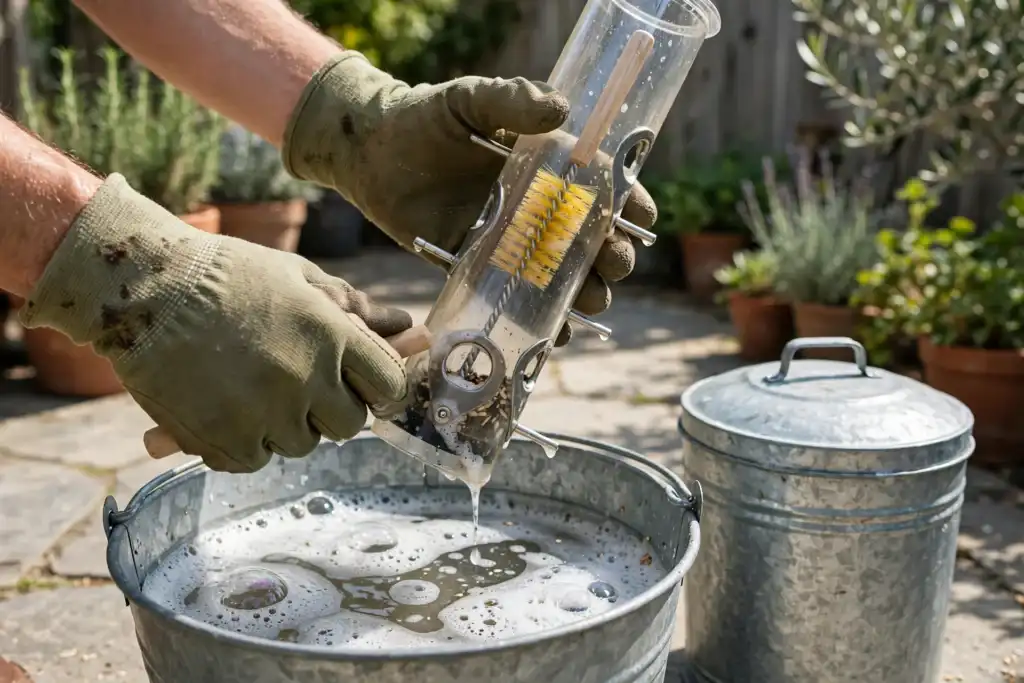
Clean nectar feeders with hot water and a bottle brush each time you change the nectar. Clean suet cages once a month and platform feeders once a week. Rake up hulls and droppings once every couple of weeks.
If you find any sick birds with puffy or crusty eyes, struggling to breathe, or unable to fly, remove all feeders for two weeks, clean them, and do not scatter any seed on the ground.
Keeping Seed Dry
Wet seed is wasted seed. Damp seed grows mold, and moldy seed can carry toxins that harm birds. The Cornell Lab of Ornithology recommends that you never let seed get wet, because corn is most likely to contain aflatoxins.
Buy small amounts of seeds so they can be used within a few weeks. Store it in an airtight metal container in a cool dry place. Metal will keep out mice and squirrels.
Choose feeders with a roof or dome. Throw away any clumpy, wet, and smelly seed after it has rained, and clean the feeder before refilling it.
Squirrels and Other Feeder Raiders
The most common animals to raid your feeders will be squirrels. They are very determined, intelligent, and strong. Raccoons, rats, mice, starlings, and grackles will also eat from your feeders.
Squirrel-proof pole feeders with a baffle are best. Put your pole in an open area, and make sure it is at least 8 to 10 feet away from anywhere they can jump from. Safflower seed will also help, as squirrels tend to ignore it.
Never use any greasy products or sticky glues. This can get onto the feathers and fur. Never use poison, as this will kill your birds, pets, and wildlife. If you are still losing to the squirrels, create an area for them to feed on with corn and peanuts, well away from your bird feeders. For starlings, read our guide on how to keep starlings away from bird feeders.
How to Attract More Feeder Birds
Getting birds to visit is generally a question of patience, variety, and providing the right habitat. A garden with food, water, and shelter will attract more birds than just feeders.
Provide a variety of foods using a variety of feeders. Black oil sunflower in a hopper, nyjer in a thistle feeder, and suet in a cage will provide a variety of diets while spreading out the birds.
Add water. Providing a birdbath or a shallow dish with a dripper will attract birds who would not come to seed feeders such as robins, warblers, and thrushes. Keep the water shallow and change it every few days.
Plant native trees, shrubs, and flowers. This provides a food source for insects and seeds, berries, and cover.
Mistakes to Avoid
There are a few simple fixes for common errors that leave feeders empty and/or dangerous.
- Filling a feeder once and forgetting it: Forgetting to refill means the feeder will be empty and birds will learn to avoid it. Stale seed will also mean they avoid it.
- Buying cheap filler mixes: Those containing lots of red milo, wheat, and oats will mean you are wasting your money as they will rot on the ground.
- Using red dye in nectar: Red food coloring is not needed, and plain sugar water works just as well.
- Offering bread, salted nuts, or seasoned food: Bread does not have a lot of nutrition, and salt is bad for the birds.
- Skipping cleaning: A dirty feeder will spread disease quicker.
Frequently Asked Questions
How long does it take for birds to find a new feeder?
Most feeders will attract visitors in a few days to two weeks, and will generally get a regular flow of birds in two to four weeks. Chickadees and titmice are often the first visitors.
What is the best food for feeder birds?
The best single food is black oil sunflower seed. It will attract the most variety of birds. It has a very thin shell and is high in fat. Nyjer and suet can be added to attract finches and woodpeckers.
Do I need to feed birds all year?
Feeding is not an obligation. Most feeder birds will find natural foods in the summer. However, those that have become used to feeding at your feeder will need it topped up over the winter, particularly during cold periods.
Why do birds throw seed on the ground?
Birds toss seed aside to get to the seeds they want. Ground-feeding birds like doves, juncos, and sparrows will also eat up any seed that falls. If most of your seed is falling to the ground, then it is likely to contain filler.
How do I keep squirrels off my bird feeders?
Mount a pole feeder on level ground far away from any trees or fences (at least 8 to 10 feet away). Place a smooth metal baffle beneath the feeder. Squirrels usually don’t bother with safflower seeds.
Sources
- Cornell Lab of Ornithology, Project FeederWatch: https://feederwatch.org/
- Cornell Lab of Ornithology, All About Birds: https://www.allaboutbirds.org/news/
- National Audubon Society, 11 Tips for Feeding Backyard Birds: https://www.audubon.org/magazine/11-tips-feeding-backyard-birds
Conclusion
Feeder birds are the easiest wild birds to observe and help. If you have the correct feeders, you will attract cardinals to your hopper, chickadees to grab some sunflower seeds, goldfinches to your thistle feeder, and woodpeckers to your suet cage. Simply fill up your feeders with the correct food types (black oil sunflower seed, nyjer, suet, and nectar) and place them near cover but away from windows. Clean and dry your feeders, and use a pole and baffle to stop squirrels getting to your feeders. Start with 1 or 2 feeders and see what you attract. As you learn which birds come to your yard, add more variety. Once you have set up your feeders, the birds will do the rest and your yard will never look empty again!