
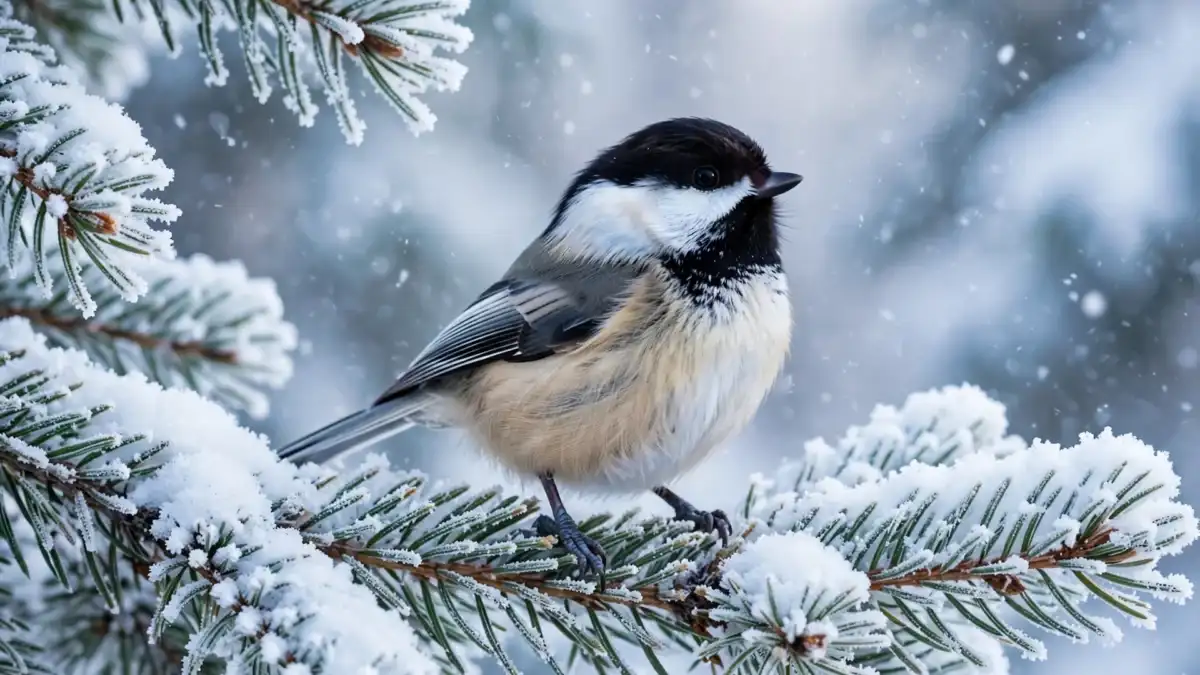
A black-capped chickadee weighs about as much as two sugar cubes. On a January night in Minnesota or Alaska, when the thermometer sinks well below zero, that tiny bird should freeze solid before midnight. It doesn’t. Instead, it rides out the cold with a toolkit of adaptations so effective that chickadees never bother migrating.
The question of how chickadees survive winter has kept biologists busy for decades, and the answer is a sequence of strategies, each one remarkable on its own.
From a brain that remodels itself every fall to a nightly plunge in body temperature that borders on torpor, chickadees are built for winter the way a sports car is built for speed. Here are the seven mechanisms, counted down from impressive to unbelievable.
The Short Answer
Chickadees survive winter by stacking several defenses at once. They fatten up in fall, fluff their feathers into a living down jacket, shiver to make heat, tuck into sheltered microhabitats, sleep in insulated tree cavities, and cache thousands of seeds in hidden spots they remember with a rebuilt brain.
Their headline trick is nocturnal hypothermia: each night they let their body temperature drop by roughly ten degrees, cutting the energy they burn while they sleep. Together these strategies let a 12-gram bird survive nights that would kill a human in hours.
The 7 Superpowers at a Glance
| Rank | Superpower | What It Does | Energy Saved |
|---|---|---|---|
| 7 | Fall Metabolic Ramp-Up | Builds fat reserves before winter | Fuel for the coldest nights |
| 6 | Feather Fluffing | Traps insulating air against the skin | Cuts heat loss dramatically |
| 5 | Shivering Thermogenesis | Generates heat through muscle activity | Maintains core temperature |
| 4 | Smart Microhabitat Choice | Seeks the warm side of trees and thickets | Avoids wind chill |
| 3 | Cavity Roosting | Sleeps in insulated tree holes | Stays several degrees warmer |
| 2 | Food Caching and Spatial Memory | Hides seeds and remembers locations | Guaranteed winter food supply |
| 1 | Nocturnal Hypothermia | Drops body temperature overnight | Burns far less energy asleep |
7. The Fall Metabolic Ramp-Up: Fueling Up Before the Freeze
Long before the first hard frost, chickadees start eating like it is their job. Through September and October they forage almost constantly, converting seeds and insects into a layer of subcutaneous fat. A black-capped chickadee can add several grams of fat in autumn, a huge proportional gain for a bird that weighs 12 grams to begin with.
Northern birds take this further than southern ones. Research on black-capped chickadees shows that populations in Alaska carry larger fat reserves and run higher metabolic rates than their counterparts in milder climates, a built-in regional tuning of the same basic strategy.
This reserve is the bird’s insurance policy. On nights too cold or stormy for foraging the next day, stored fat bridges the gap between dusk and dawn. Without it, the rest of the toolkit would not be enough.
6. Feather Fluffing: The Down Jacket That Grows Back
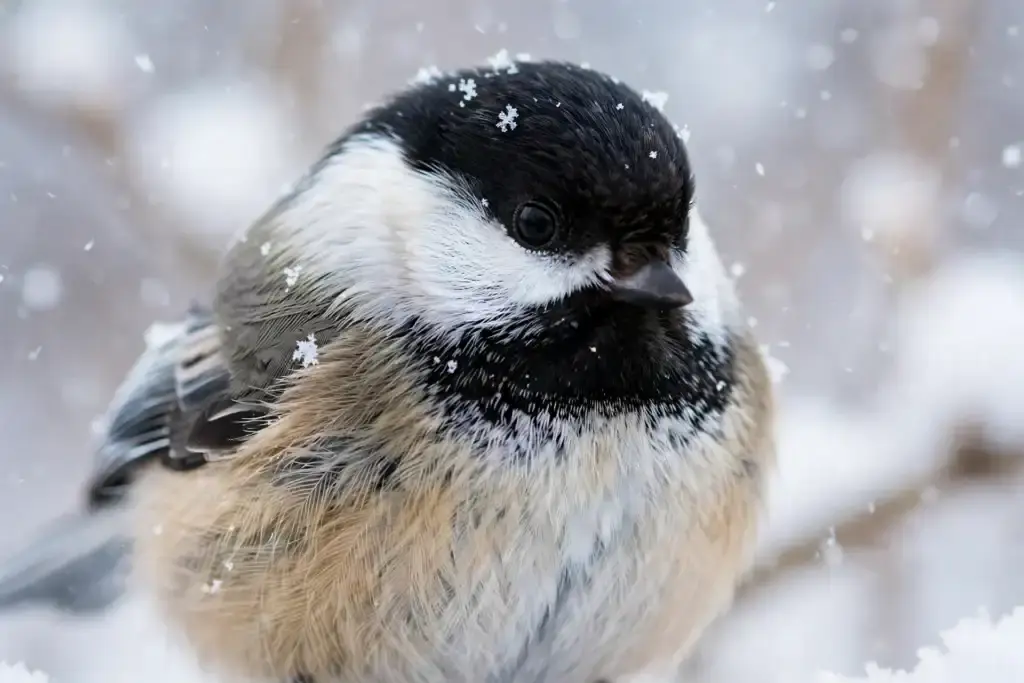
Watch a chickadee on a frigid morning and it looks like a different bird: round, puffed, almost spherical. By erecting its contour feathers, the chickadee traps a thick layer of still air against its skin. Still air is a superb insulator, which is exactly why down jackets and double-glazed windows work on the same principle.
A fluffed chickadee can look twice its summer size, but the transformation is more than cosmetic. Feather insulation is so effective that a chickadee’s skin temperature can stay close to normal even when the air around it is far below freezing. In late summer chickadees molt into a denser winter plumage, adding to the effect before the cold even arrives.
This insulation matters most at the body’s surface, where heat escapes. By maximizing the boundary layer of warm air, the bird slows the constant leak of body heat into the cold, reducing the fuel it must burn to stay warm.
5. Shivering Thermogenesis: The Furnace Without the Tremble
Chickadees generate heat by shivering, rapidly contracting their flight muscles. Unlike the visible shudder of a cold human, a chickadee’s shivering happens at high frequency and low amplitude, producing warmth without wasting motion. Their large pectoral muscles, built for flight, double as furnaces.
A shivering chickadee can raise its metabolic rate to several times its resting level. On the coldest nights, heat production runs nearly continuously, fueled by the fat reserves built up during the fall ramp-up.
Shivering is expensive, which is why the bird pairs it with every energy-saving trick available. Insulation reduces the heat that must be replaced, hypothermia reduces the hours of full-temperature operation, and cached food guarantees the fuel keeps coming.
4. Smart Microhabitat Choice: Picking the Warm Side of the Tree
Where a chickadee spends the day matters almost as much as how its body works. On sunny winter days, chickadees forage on the sunlit side of trees and shrubs, soaking up radiant heat. They avoid exposed, windy perches in favor of dense conifers that break the wind.
Winter chickadee flocks roam a home range the birds know intimately from the breeding season. They remember which thickets shelter them from prevailing winds and which sunny edges warm up first in the morning, and they plan their foraging routes accordingly.
This is a behavioral adaptation rather than a physiological one, but it is no less important. A bird that chooses a wind-sheltered foraging spot can save a measurable fraction of its daily energy budget.
3. Cavity Roosting: A Heated Bedroom Made of Wood
At dusk, chickadees abandon the open branches and retreat into tree cavities: old woodpecker holes, natural hollows, sometimes nest boxes. Inside a cavity, the air is still and several degrees warmer than outside, and the bird’s own body heat warms the small space further.
Chickadees typically roost alone, each bird in its own cavity, though they may use the same hole for many nights running. Before settling in, a chickadee fluffs its feathers and tucks its bill into its shoulder feathers, minimizing exposed skin.
A chickadee without a cavity is in trouble. Studies of winter mortality show that birds excluded from sheltered roosts burn through their reserves far faster, which is one reason nest boxes and standing dead trees matter so much in winter.
2. Food Caching and Spatial Memory: A Brain That Rebuilds Itself
In autumn, a black-capped chickadee becomes a compulsive hoarder. It wedges seeds, nuts, and insects into bark crevices, under eaves, and among pine needles, scattering each item in its own hiding spot rather than piling food in one place. A single bird can cache hundreds of items a day and tens of thousands over a season.
This scatter-hoarding strategy pays off all winter. Instead of hoping to find food, the chickadee retrieves its own hidden stores, each one a small packet of energy exactly where it left it. Researchers estimate that cached food can supply a substantial share of a chickadee’s winter diet. For a deeper look at how birds plan ahead, see our guide to how birds store food for winter.
This seasonal brain remodeling is one of the most remarkable findings in bird biology. The hippocampus, the brain region that handles spatial memory, grows new neurons each fall as caching peaks, then shrinks back in spring. The bird literally rebuilds its memory center for the season it needs it most.

1. Nocturnal Hypothermia: The Controlled Cool-Down
This is the superpower that headlines the countdown. On cold nights, chickadees deliberately let their body temperature fall from the normal 42°C (107°F) to as low as 30°C (86°F), entering a state of regulated hypothermia. They are not quite in torpor like a hibernating mammal, but they are close.
This regulated hypothermia saves an enormous amount of energy. By cooling down, the bird reduces the temperature difference between its body and the frigid air, which slows heat loss dramatically.
A chickadee in hypothermia can cut its overnight energy expenditure nearly in half compared to staying at full operating temperature. For more on how birds handle the cold, see how birds find food in winter and the All About Birds guide to the black-capped chickadee.
It is controlled, not accidental. The chickadee’s brain monitors its temperature and energy reserves through the night, adjusting the depth of hypothermia to match conditions. Before dawn, the bird shivers itself back up to full temperature, ready to forage at first light.
How to Help Chickadees in Winter
Chickadees manage winter on their own, but a little help from backyard birders goes a long way. If you want to support your local chickadees through the coldest months, learn what chickadees eat and focus on these essentials:
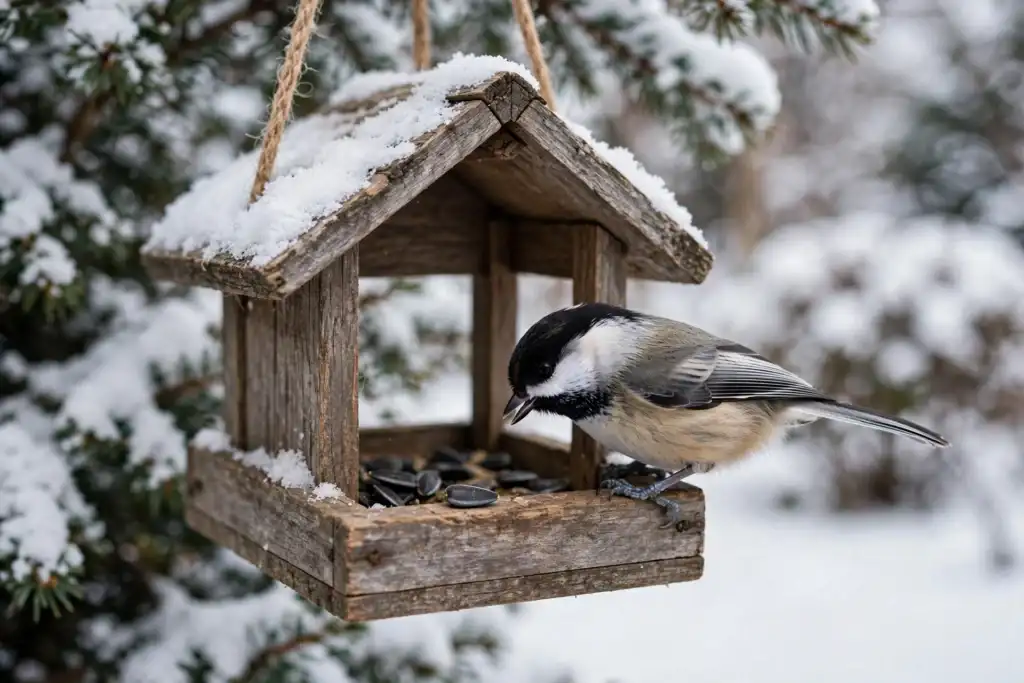
- Food: Offer black-oil sunflower seeds, peanuts, and suet. High-fat foods match the fuel chickadees burn overnight.
- Water: A heated birdbath gives chickadees drinking water when natural sources freeze.
- Shelter: Leave dead trees standing where safe, and put up roost boxes for extra cavity options.
- Safety:Keep cats indoors, especially at dawn and dusk when chickadees are most vulnerable.
- Quiet: Avoid disturbing roosting areas on bitterly cold evenings.
Frequently Asked Questions
Do chickadees migrate in winter?
No. Chickadees are permanent residents throughout their range. Both black-capped and Carolina chickadees stay on territory year-round, which is precisely why their winter adaptations are so extreme. Only the most northern populations make short irruptive movements in years when food is scarce.
How cold can a chickadee survive?
Black-capped chickadees routinely endure temperatures well below freezing, including stretches of minus 20 degrees Fahrenheit and colder. Their survival depends on the full toolkit: fat reserves, insulation, sheltered roosts, and nightly hypothermia. Wind and wet conditions are more dangerous than cold alone.
Do chickadees sleep in groups to stay warm?
Generally no. Chickadees roost alone in individual tree cavities. Some other small birds, such as wrens and bluebirds, do huddle communally, but chickadees rely on sheltered cavities and hypothermia instead of shared body heat.
What do chickadees eat in winter?
Seeds, nuts, suet, and cached food items, supplemented by dormant insects and eggs gleaned from bark. At feeders they prefer black-oil sunflower seeds, peanuts, and suet. To learn more, see what chickadees eat and how birds store food for winter.
Do Carolina chickadees use hypothermia too?
Yes, though less dramatically. Carolina chickadees, which live in milder climates, use shallower nightly temperature drops than black-capped chickadees. The National Wildlife Federation notes that chickadees are tougher than they look, with both species adjusting their physiology to local conditions.
How long do chickadees live?
Wild chickadees typically live 2 to 3 years, though banded individuals have reached 10 or more. Winter is the great filter: first-year birds face the steepest odds. The National Park Service documents the black-capped chickadee’s life history, and the guide to how birds find food in winter explains the foraging skills that keep them alive.
The Bottom Line
Chickadees survive winter not through one miracle but through seven: fat reserves built in fall, feathers that become a down jacket, shivering muscles that run like a furnace, smart use of sun and shelter, insulated cavities, a memory that maps thousands of hidden seeds, and a nightly cool-down that stretches every calorie.
A bird that weighs less than half an ounce outlasts the coldest months of the year on planning, physiology, and grit. Keep your feeders full, your dead trees standing, and your cats indoors, and you will have a front-row seat to one of nature’s great cold-weather performances.