
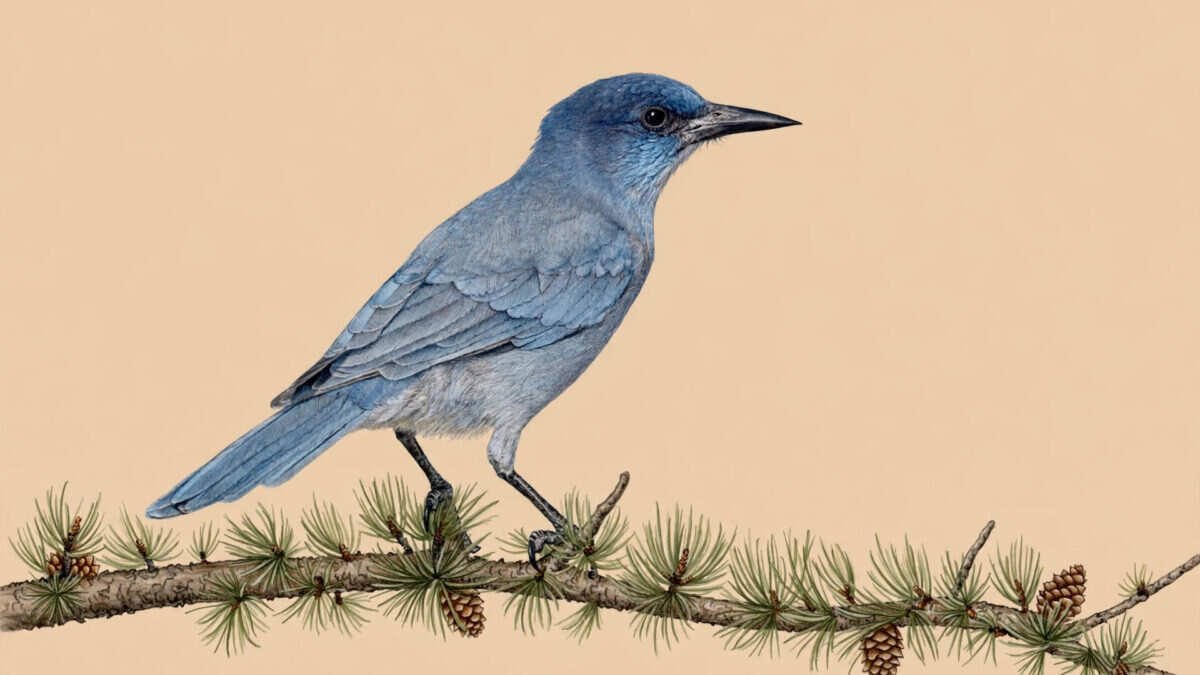
The pinyon jay irruption of 2026 has been remarkable. Pinyon Jays are western pinyon pine foothill birds. This year they have been seen on the California coast, and on offshore islands where they have never been seen before. They have also been seen in large numbers close to the Mexican border, in densities birdwatchers describe as highly unusual.
Clark’s Nutcrackers are on the move with them, appearing on several of the Channel Islands for the first time and traveling through southern California valleys in large numbers (even by eBird standards).
If you live in the West, this winter, keep your eyes peeled and your phone charged. The dusty blue jay at your feeder may not be the scrub-jay you expect. The large gray bird with white wing patches, calling harshly from a pine, may actually be a nutcracker far from its mountain home.
This article explains why both species are on the move, how to identify them from similar species, where they are likely to be seen, and what you should and should not do if one lands in your yard.
Pinyon Jay Irruption 2026: What Is Happening
The American Bird Conservancy reported on 15 October 2026 that this year’s Pinyon Jay migration is without precedent, in one specific, striking way. This species has never been recorded in southern California or on any of the islands off the coast, including San Clemente Island, the Channel Islands, and Santa Catalina Island.
A flight over the Pacific to an island is far from normal for a bird that usually lives year-round in the foothills and lower mountainsides of the western United States and northern Mexico. Such a flight indicates that normal food sources have failed on a wide scale.
Clark’s Nutcrackers are also telling the same story, but from a different mountain home. The current Winter Finch Forecast update highlights that the strongest nutcracker irruption is currently happening at the southwestern extremes of their range. They are passing through the hills and lowlands of southern California, Mexico, and the southwestern deserts in unprecedented numbers according to the eBird database.
Nutcrackers made flights across the Pacific to visit the Channel Islands in late September. This was the first occurrence on several of the islands. Birds have also reached the Pacific Coast Ranges and may show up in unusual locations across the West.
Pinyon Jays have expanded to the edge of their range in the same southwestern regions. The forecast notes that they are irrupting onto the California coast for the first time in over two decades, perhaps to the greatest extent ever recorded. They have established new records on the Channel Islands, and are in highly unusual densities near the Mexican border in Arizona and New Mexico.
Wanderers are also flying in the Northern Great Basin, although the northern populations do not appear to be irrupting as strongly as the southern ones. Pinyon Jays have also moved onto the southern Great Plains, staying within the bounds of previous larger movements. In September, Pinyon Jays were reported from Lincoln County, Wyoming, and a flyover in Sublette County.
One report from central New Mexico shows how high the numbers are. People counted nearly 200 Clark’s Nutcrackers in one area, alongside Pinyon Jays in a place where, in the reporter’s words, their presence was basically unheard of. Single birds can be easy to dismiss as lost or misidentified. But when you are finding hundreds of birds across different states at the same time, it cannot be a coincidence. They are a pattern, and the pattern points to food.
Why a West-Wide Pine Nut Crop Failure Drives the Movement
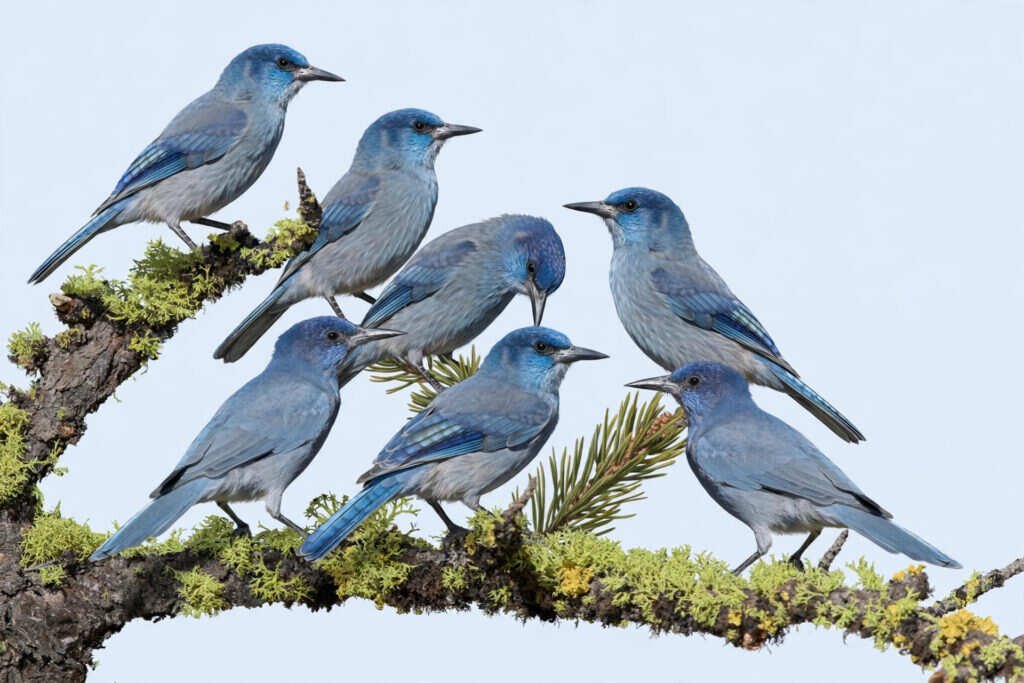
Pinyon Jays are dependent on pine nuts for their diet. They eat them, cache them for winter, and remember thousands of cache sites. If there is a good crop of pinyons, the flock will have food for months. However, if there is a poor crop of pinyons, the flock must make a difficult decision: stay and search harder in a landscape with little food, or irrupt and try to find better trees elsewhere. Irruption is the second choice, taken at scale.
According to the article by the American Bird Conservancy, Scott Somershoe, a biologist with the United States Fish and Wildlife Service based in Denver, links the movement to inadequate food resources. He notes that the West had so little snow last winter that cones developing at the time were largely aborted.
Overall, it is likely that there was a west-wide nut crop failure, not just for several pinyon pine species but for ponderosa and Jeffrey’s pines as well. That breadth matters: if only one species had failed, birds might have switched to another. When several fail together, there is nowhere local left to switch to.
Cone production is cyclical. On average, there is a good mast year every couple of years, and the timing varies by pinyon pine species. Some years of reduced production are more extreme than others. Persistent drought and rising temperatures, especially during key stages of cone development, can cause trees to abort cone development or produce nonviable seeds.
Cone development takes place over two years, so temperature and rainfall need to be right at the right times. Trees can look loaded with cones while the nuts inside are not usable as food. That distinction, between a tree that looks productive and one that actually feeds birds, is central to this irruption.
Good years also create bad years. An abundant crop can increase the number of birds, because more young survive and more birds breed successfully. However, when a poor year follows a good one, a larger population faces a smaller food supply. The result is movement, and sometimes movement on a scale that surprises even experienced birdwatchers. For background on how food-driven movements work in other finches and jays, see our guide to winter finch irruptions explained, and the guide to how birds find food in winter.
How to Identify a Pinyon Jay
A Pinyon Jay is a medium-sized, dusty blue jay with a long, fairly straight dark bill and a short tail. Unlike the California Scrub-Jay, it has no bold white eyebrow and no bright blue, black, and white pattern. It also lacks the crest of a Steller’s Jay. In good light, the blue looks muted, almost gray-blue, with a paler throat and a slightly darker head. The bill is a useful mark on its own. It is longer and more dagger-like than a scrub-jay’s bill, and the bird often holds it slightly open or uses it to probe bark and soil.
Behavior helps even more. Pinyon Jays are very social and often travel in large flocks. They stay in contact with a range of calls, including a nasal, crow-like “kaw” and a rolling chatter. A lone blue jay on a fence will most likely be a scrub-jay. If you see a flock of 20 or 50 dusty blue birds, all flying together through pines and calling constantly, think Pinyon Jay first, especially this winter and especially outside their normal range.
Juveniles are grayer and duller than adults, with a pinkish gape at the base of the bill when young. They can look plain at first glance, but the flock context, the long bill, and the short tail still point the right way. If you see a flock, watch for the adults. They will usually be mixed in with younger birds, and their blue color is clearer.
How to Identify a Clark’s Nutcracker
A Clark’s Nutcracker is unmistakable once you know it, and easy to overlook if you do not. It is a large, pale gray bird with black wings marked by bold white patches, a black tail with white outer feathers, and a long, sharp black bill. In flight, the white wing patches flash conspicuously.
The bird sits up on its perch looking clean and pale, almost like a gray crow with white on the wings. Larger than a jay but smaller than a raven, it has a long bill that gives it a distinctive profile.
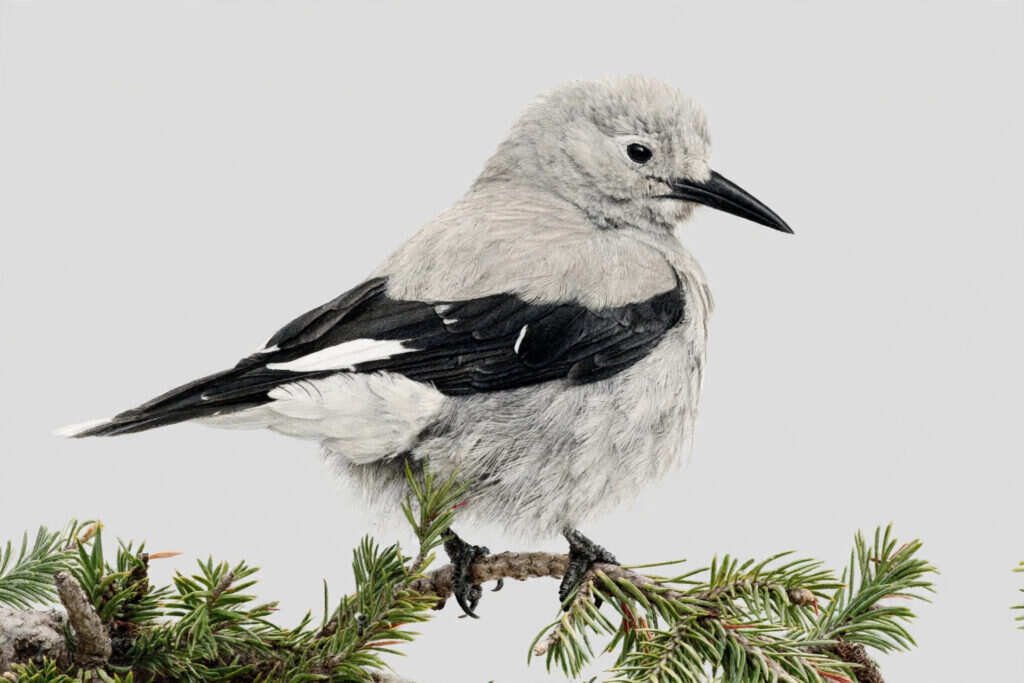
Nutcrackers are quite vocal, with a harsh, grating “kraa” call that carries a long way. They are quite bold around people in mountain campgrounds, because they have learned that picnic areas can be a source of food. However, irrupting birds in lowland valleys may be shyer and more mobile. If you hear a harsh crow-like call from a pale gray bird in a pine, look for the white wing patches. No western jay has that combination.
Comparison table: Feature / Pinyon Jay / Clark’s Nutcracker / California Scrub-Jay. Overall color: Dusty blue-grey, no crest / Pale grey with black and white wings / Bright blue, white, and black, no crest. Bill: Long, dark, dagger-like / Long, sharp, black / Shorter, stouter. Tail: Short / Medium, black with white edges / Long. Social pattern: Large, noisy flocks / Singles, pairs, or loose groups / Singles, pairs, or family groups. Key call: Nasal kaw, rolling chatter / Harsh grating kraa / Harsh, varied jay calls.
Where the Birds Are Turning Up
This winter, the map is wider than usual. In California, look beyond the mountains. Coastal areas, the Channel Islands, Santa Catalina Island, and San Clemente Island have all produced first records or new records this autumn. The valleys of southern California should also be checked, as nutcrackers have been seen coming down from the hills. Check any area with pines, oaks, and open foothill country. If you see a bird in a lowland park or a suburban pine grove, it is not necessarily a misidentification this year. Check it.
In Arizona and New Mexico, densities near the Mexican border are unusually high, and central New Mexico has produced large nutcracker counts. Pinyon Jays have been reported in Lincoln County, Wyoming, and as a flyover in Sublette County. In the Northern Great Basin, wanderers are in flight, though the movement there appears less strong than in the south. That north-to-south difference fits the food story. The southern populations suffered the worst crop failure, so they moved furthest.
Wherever you are in the West, the practical advice is the same. Check pinyon pine stands first, then ponderosa and Jeffrey’s pine areas, then mixed foothill woodland with oaks and junipers. If possible, also check migration corridors and island sites. Check your own neighborhood pines, because irrupting birds often settle where they find a few productive trees, even in towns. Report what you find, with a location and a count, because the edge of an irruption is exactly where new records are made.
What to Do If One Visits Your Feeder
Stay calm, watch, and record. Pinyon Jays may visit feeders for sunflower seed, peanuts, and suet, especially when natural pine nuts are scarce. Nutcrackers visit feeders less regularly, but they may take peanuts and sunflower seed if they pass through a yard. Offer food in a platform feeder or on a tray where a larger bird can land comfortably. Keep the feeder clean, and keep cats indoors while the birds are present, if you can.
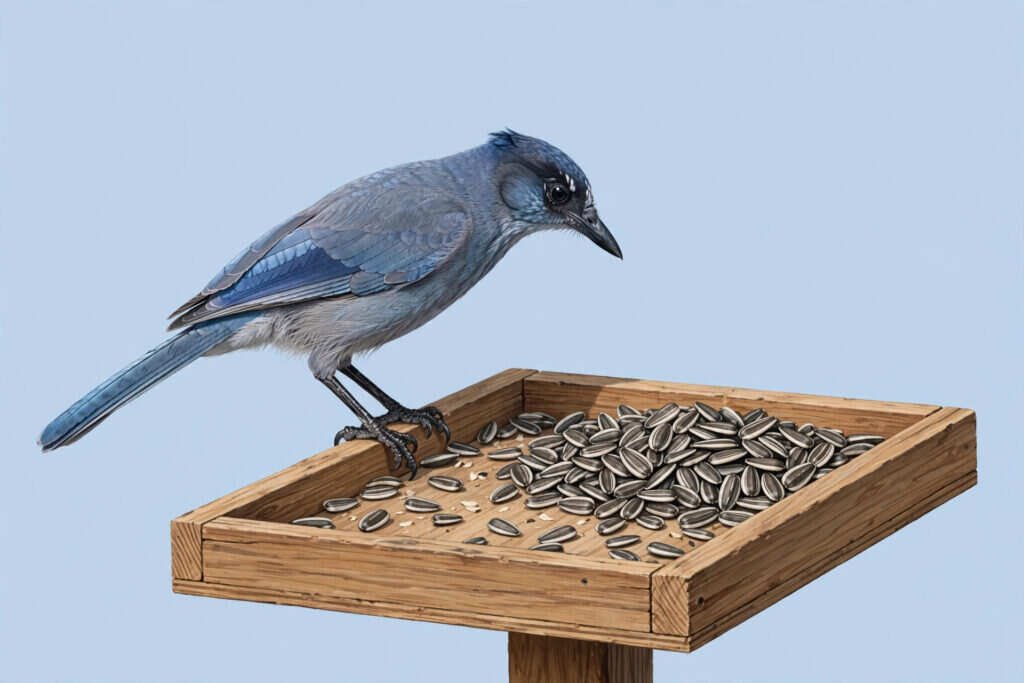
Do not try to catch, handle, or feed a bird by hand. Do not play recorded calls repeatedly to lure a flock closer. A short playback to confirm an identification, used sparingly, is different from continuous playback that can stress birds and draw them away from feeding. Take photographs and, if the birds are calling, a sound recording. Note the number of birds, the time, and what they ate. That detail helps researchers understand how irrupting birds use human-provided food when wild food fails.
Even if only visiting once, don’t assume they will stay. Irrupting flocks are mobile. They may feed in your yard for an hour and be gone by afternoon, or they may return for days if the food holds. Keep the feeder stocked through the irruption period, and keep watching nearby pines. A flock that leaves your feeder may still be in the neighborhood, working a pine stand a street away.
What This Irruption Means, and What It Does Not Mean
An irruption is exciting, but it is also a warning sign. American Bird Conservancy frames this movement as both exciting and worrisome, and that balance is right. Birds that travel far beyond their usual range are birds under food stress.
Some individuals will have sufficient food in their new locations to survive the winter. However, some will not. A winter with many sightings is not automatically a winter with a healthy population. It can be a winter when a population is struggling, and its struggle is simply more visible.
At the same time, a single irruption does not prove a long-term decline on its own. Pinyon Jays have irrupted in the past, and there have been major nutcracker movements in previous years. What makes 2026 stand out is the geographic extent, the island records, and the west-wide nature of the crop failure.
It will take researchers several years of data, including breeding success next spring and survival through winter, before they can say how much this event matters for the population as a whole.
What you can do is modest and useful. You can record any sightings, noting how many there are and making recordings. Keep feeders clean and stocked if birds visit. Avoid disturbing flocks that are feeding or resting. Support habitat work that protects pinyon pine woodlands, which are under pressure from drought, fire, and development as well as from crop failures. To get a broader picture of what happens to the birds when their food sources change, look at where birds go in winter.
Frequently Asked Questions
Is the pinyon jay irruption 2026 really unprecedented?
The term “unprecedented” in the American Bird Conservancy report refers to specific records, especially Pinyon Jays in southern California and on offshore islands where they had not been seen before, and the scale of the movement in the southwest. While Pinyon Jays have irrupted before, this combination of island firsts, coastal records, and west-wide crop failure is what makes 2026 stand out.
How do I tell a Pinyon Jay from a scrub-jay?
Look for a dusty blue bird with no crest, a long dark bill, a short tail, and seen in flocks. Scrub-jays have a more vivid blue and white coloration, with a bolder pattern, a shorter bill, and a long tail. They are usually seen singly or in small family groups. Flock size and bill length are often the fastest clues.
Are Clark’s Nutcrackers related to crows?
Yes, in the broad sense. Nutcrackers, jays, and crows all belong to the corvid family. Nutcrackers are specialized for pine seeds, which they cache in large numbers and remember well. Because of this, they are important to pine forests. If they cannot find all their stored seeds, then new trees can grow from them.
Will Pinyon Jays stay in California all winter?
Some may, if they find enough food. However, others will continue to move on as local food supplies run out. Island birds face a particular challenge, because an island has a limited food supply. Don’t assume that just because you see a bird in October, it will still be there in January. Keep checking and keep reporting.
Should I feed Pinyon Jays peanuts?
Unsalted peanuts (shelled or in the shell) and black oil sunflower seed are a good choice in a platform feeder. Avoid salted nuts and seasoned mixes. Bread should also be avoided. Regularly clean your feeder, and do not allow large amounts of uneaten food to become moldy in damp conditions.
Why are nutcrackers on islands such a big deal?
As nutcrackers are a mountain species, it is unusual for them to travel across open water to reach an island. The first records on several Channel Islands show how far food stress can push a bird, and they give researchers a rare chance to study how a mountain species uses island habitat.
Conclusion
The 2026 irruption gives western birdwatchers a rare window into Pinyon Jays and Clark’s Nutcrackers, normally tied to mountain pine forests, now visiting coastal towns, valleys, deserts, and islands in search of food that failed at home.
It’s pretty straightforward: a west-wide pine nut crop failure, worsened by low snow, drought, and heat at the wrong stages of cone development. The consequence is a winter when a careful observer in the wrong place, by old range maps, can find the right bird.
Learn the two profiles. Pinyon Jay: dusty blue, long-billed, short-tailed, in a noisy flock. Nutcracker: pale gray, black and white wings, long-billed, harsh-voiced. Check pines, check valleys, check islands if you can, and check your own feeder.
Record calls, count birds, and report what you find. An irruption is a story written in real time, and every careful sighting helps write the next chapter. Sources for this article include American Bird Conservancy’s report on the 2026 Pinyon Jay irruption and the Finch Research Network’s Winter Finch Forecast 2026-2027 update.