

Penguins only live in the Southern Hemisphere, but can be found from the sea ice of Antarctica to the equator. There are 18 different species of penguin, ranging from the emperor penguin (taller than a toddler) to the little penguin (just slightly bigger than a pigeon). These are recognized by BirdLife International and the IUCN.
This guide profiles every one of them, with sizes, ranges, and conservation status, so you can tell them apart and know which ones are in trouble.
How Many Types of Penguins Are There?
The number of species can vary depending on which authority you look at. BirdLife International and the IUCN list 18 species. This is what will be used in this guide. However, newer checklists such as AviList and the Cornell Clements checklist list 19 species due to splitting the southern rockhopper into the western and eastern species.
The 2026 proposal to split the gentoo penguin into four species has yet to be adopted by any major checklist. Older books that list 16 or 17 species often combine rockhoppers into one species or combine the various forms of the little penguin. While none of these counts are wrong, 18 is the number used for the IUCN Red List statuses quoted here.
All penguins belong to one family, Spheniscidae. They are flightless seabirds, and every species swims with stiff, flattened wings that work like flippers underwater.
Penguin Species at a Glance
Heights are typical adult ranges and vary slightly by source. Conservation status is the current IUCN Red List category.
| Penguin | Height | Where it lives | IUCN status |
|---|---|---|---|
| Emperor | About 115 cm | Antarctic coast and sea ice | Endangered |
| King | About 95 cm | Subantarctic islands | Least Concern |
| Gentoo | About 80 cm | Antarctic Peninsula and subantarctic islands | Least Concern |
| Chinstrap | About 70 cm | Antarctic Peninsula and nearby islands | Least Concern |
| Macaroni | About 70 cm | Subantarctic islands, circumpolar | Vulnerable |
| Royal | About 70 cm | Macquarie Island only | Least Concern |
| Adelie | About 70 cm | Antarctic coast and islands | Least Concern |
| Little | About 33 cm | Southern Australia and New Zealand | Least Concern |
| African | About 65 cm | South Africa and Namibia | Critically Endangered |
| Magellanic | About 70 cm | Southern South America and the Falkland Islands | Least Concern |
| Humboldt | About 65 cm | Peru and Chile | Vulnerable |
| Galapagos | About 50 cm | Galapagos Islands | Endangered |
| Yellow-eyed | About 70 cm | New Zealand | Endangered |
| Fiordland | About 55 cm | South Island, New Zealand | Near Threatened |
| Erect-crested | About 60 cm | Antipodes and Bounty Islands | Endangered |
| Snares | About 60 cm | Snares Islands, New Zealand | Vulnerable |
| Southern rockhopper | About 50 cm | Subantarctic islands near South America | Vulnerable |
| Northern rockhopper | About 55 cm | Tristan da Cunha, Gough, and Amsterdam Island | Endangered |
The Great Penguins
Emperor Penguin
The emperor penguin (Aptenodytes forsteri) is the largest living penguin, reaching heights of around 115 cm and weights of up to 40 kg. They breed on Antarctic sea ice in winter, making them the only penguin to breed on sea ice. The males will incubate the single egg on their feet for months during the dark and stormy winter.
Emperor penguins feed mainly on fish, krill, and squid, and dive deeper than any other penguin species. In April 2026, BirdLife International reclassified the emperor penguin from Near Threatened to Endangered, because sea ice loss is expected to halve the population by the 2080s.
Emperor penguins are also famous for huddling together for warmth, as explained in our guide to why birds huddle together.
King Penguin
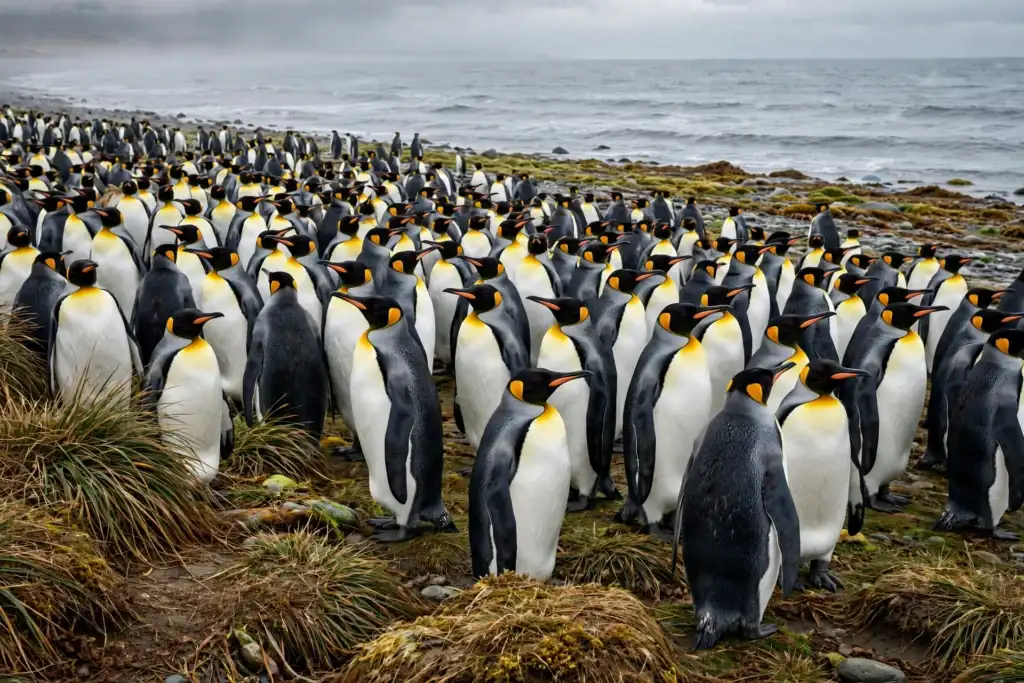
The king penguin (Aptenodytes patagonicus) is the second largest penguin. They have bright golden-orange patches on their neck and head and are about 95 cm tall. They breed on subantarctic islands and have the largest colonies on South Georgia. Like the emperor they do not have a nest and balance their single egg on their feet.
King penguin chicks have very long development periods, often taking between 14 and 16 months from laying to fledging. However, they are listed as Least Concern and have a large and stable population.
The Brush-Tailed Penguins
Adelie Penguin
The Adelie penguin (Pygoscelis adeliae), a typical Antarctic penguin, is about 70 cm tall. It has a white ring around its eyes and a black head. It breeds along the coastline of Antarctica and on nearby islands. They build nests from small stones which they both fiercely guard.
Adelies primarily eat krill and fish. They are listed as Least Concern, with an estimated population in the millions. Colonies on the Antarctic Peninsula have decreased due to changes in sea ice patterns.
Chinstrap Penguin
The chinstrap penguin (Pygoscelis antarcticus) gets its name from the narrow black strap-like band running under its chin. It stands about 70 cm tall. They breed in huge colonies around the Antarctic Peninsula and the South Sandwich, South Shetland and South Orkney Islands.
Chinstraps are among the most abundant penguins, but recent surveys show declines in several major colonies, linked to falling krill availability. The species remains listed as Least Concern.
Gentoo Penguin
The gentoo penguin (Pygoscelis papua) is the third largest of all penguins. They are about 80 cm tall and have a white stripe running across the top of their heads and an orange bill. They breed in the Antarctic Peninsula, Falkland Islands, South Georgia and other subantarctic islands, nesting in simple scrapes lined with pebbles.
The fastest penguin species is the gentoo, which can swim at speeds of about 36 km/h underwater. They are listed as Least Concern and are now seen further south along the Antarctic Peninsula as temperatures have risen.
The Banded Penguins
African Penguin
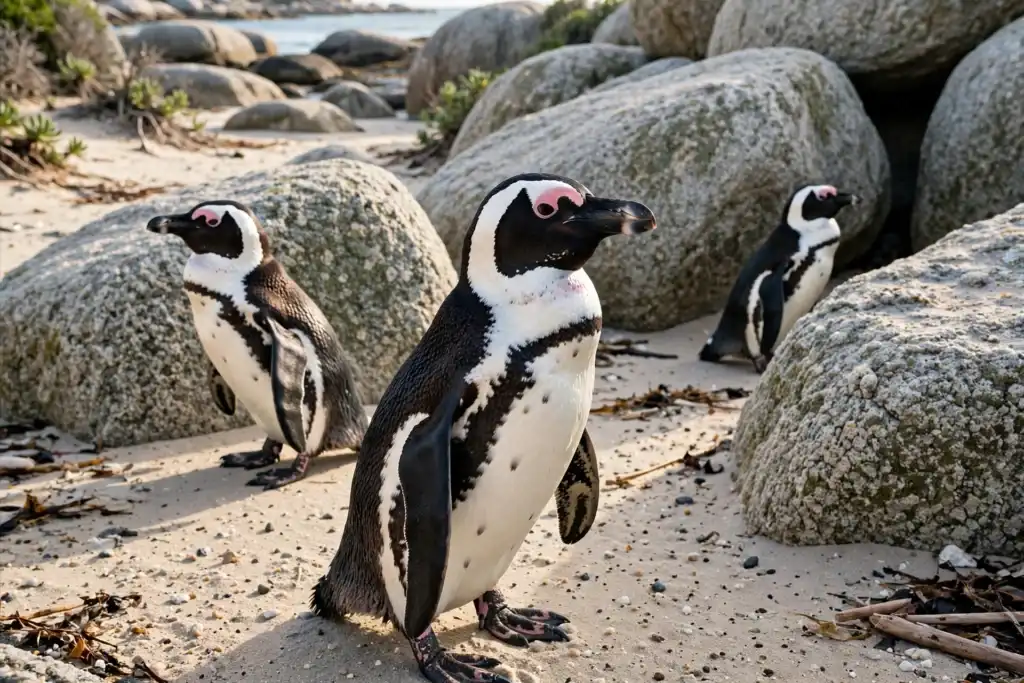
The African penguin (Spheniscus demersus) is the only penguin species to breed on the African continent around the coast of South Africa and Namibia. The African penguin is approximately 65 cm tall and has a black stripe across the chest, pink skin patches above its eyes and a loud braying call which gave it the old common name of Jackass penguin.
In October 2024 the African penguin became the first penguin to be classified as Critically Endangered, after its numbers dropped below 10,000 breeding pairs. Overfishing of sardines and anchovies, its main food, is the leading cause.
Magellanic Penguin
The Magellanic penguin (Spheniscus magellanicus) breeds along the southern coast of Argentina and Chile and on the Falkland Islands. They nest in burrows or under bushes. They are around 70 cm tall with two black bands on their chest and a white face border.
Magellanic penguins get their name from Ferdinand Magellan and were documented by his crew in 1520 during the first circumnavigation of the globe. They are listed as Least Concern but are threatened locally by oil spills and fisheries.
Humboldt Penguin
The Humboldt penguin (Spheniscus humboldti) inhabits the shores of the Pacific Ocean in Peru and Chile. The bird gets its name from the cold Humboldt Current, in which it lives. They are around 65 cm tall and nest in burrows dug into guano deposits or rocky crevices.
Humboldt penguins eat anchovies and sardines, but their numbers decline greatly in El Nino years as the warm water causes their prey to move away. The Humboldt penguin is listed as Vulnerable by the IUCN. However, Chile has separately reclassified it as endangered at the national level.
Galapagos Penguin
The Galapagos penguin (Spheniscus mendiculus) is the only penguin that can be found north of the equator. They breed on Fernandina Island and the west coast of Isabela Island in the Galapagos. They are one of the smallest penguins, at approximately 50 cm tall, but survive in tropical waters only because cool currents bathe these islands.
Galapagos penguins are listed as Endangered, with a population estimated at roughly 2,000 birds or fewer. One strong El Nino event in 1982 to 1983 wiped out an estimated 77 percent of the population, which shows how fragile a small, isolated population can be.
The Crested Penguins
Macaroni Penguin
The macaroni penguin (Eudyptes chrysolophus) is a golden-crested penguin of the subantarctic islands. They are around 70 cm tall. Their orange-yellow crest plumes sweep back from above the eyes. They have a large red bill that stands out against its black face.
Macaroni penguins are one of the most abundant penguins on Earth, with a population in the millions. However, they are listed as Vulnerable due to a dramatic decline in their population at several large colonies. Macaroni penguins mainly eat krill.
Royal Penguin
The royal penguin (Eudyptes schlegeli) looks much like a macaroni, but has a white face instead of black and a paler crest. They are about 70 cm tall and only breed on Macquarie Island, which is to the south of Australia. This means that their entire future depends on this one island.
Royal penguins were once hunted for oil, but hunting ended long ago and the population recovered. The most recent IUCN assessment lists the species as Least Concern.
Fiordland Penguin
The fiordland penguin (Eudyptes pachyrhynchus) breeds along the southwestern coast of the South Island of New Zealand. It is one of the few penguin species to nest in forest. They are approximately 55 cm tall with a yellow crest stripe and a stocky build.
Fiordland penguins are shy at their colonies, slipping ashore under cover of vegetation. They are listed as Near Threatened, threatened by introduced predators such as stoats and dogs.
Erect-Crested Penguin
The erect-crested penguin (Eudyptes sclateri) has yellow plumes on its crest that are held upright, like a brush. This bird is about 60 cm tall and breeds almost exclusively on the Antipodes Islands and Bounty Islands in New Zealand.
Erect-crested penguins are listed as Endangered, after large declines at their main colonies for reasons that are still not fully understood. Their remote breeding islands make them hard to study, which adds to the uncertainty.
Snares Penguin
The snares penguin (Eudyptes robustus) inhabits only the Snares Islands, a small island group south of New Zealand. They are about 60 cm tall, with a yellow crest, red eyes and a heavy dark bill.
Because the whole population breeds on one island group, a single disaster, such as an oil spill or the introduction of predators, could cause severe damage. This species is listed as Vulnerable.
Southern Rockhopper Penguin
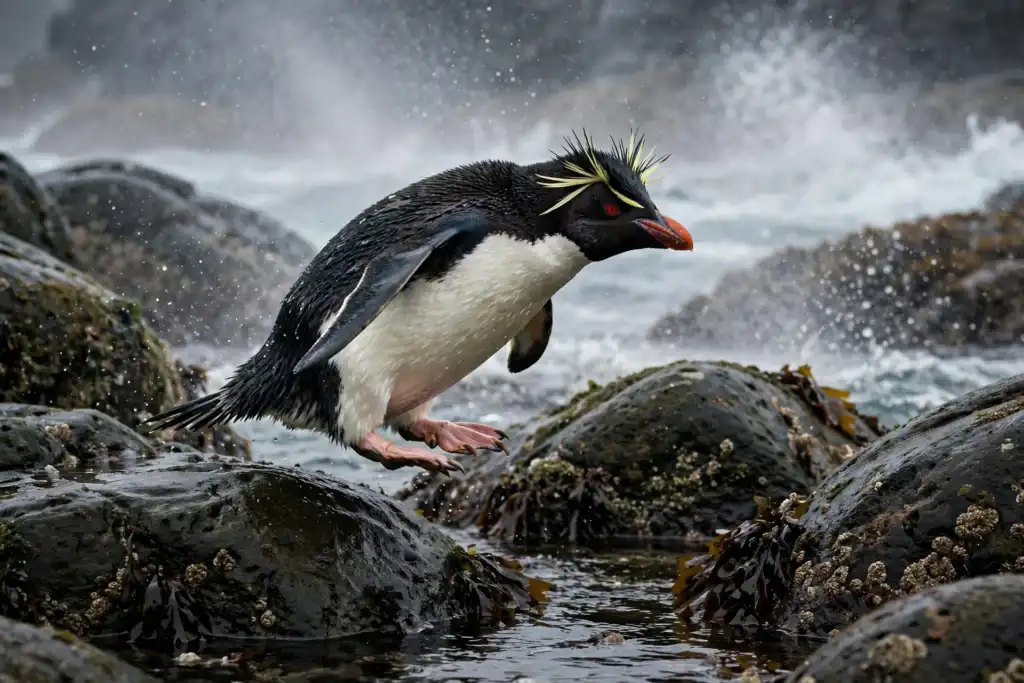
The southern rockhopper penguin (Eudyptes chrysocome) is the smallest of the crested penguins. It measures approximately 50 cm in height and has spiky yellow crest plumes and bright red eyes. These penguins breed on subantarctic islands surrounding the southern tip of South America, including the Falkland Islands.
Rockhoppers are named due to their habit of hopping over rocky shores instead of waddling. The southern rockhopper is listed as Vulnerable with the population decreasing by about one third over recent decades.
Northern Rockhopper Penguin
The northern rockhopper penguin (Eudyptes moseleyi) breeds on Tristan da Cunha and Gough Island in the South Atlantic and on Amsterdam Island in the Indian Ocean. It stands about 55 cm tall and has the longest and most swept-back crest plumes of any rockhopper.
Northern rockhoppers were once lumped with the southern species, but genetic and vocal studies confirmed them as a separate species. They are listed as Endangered, after a decline of roughly 90 percent since the 1950s.
The Little Penguin and the Yellow-Eyed Penguin
Little Penguin
The little penguin (Eudyptula minor), also called the fairy penguin, is the smallest species of penguin. They are approximately 33 cm tall and breed along the coasts of southern Australia and New Zealand. They nest in burrows, rock crevices, and even nest boxes.
Little penguins mainly come ashore after dark, which is why evening “penguin parades” at places like Phillip Island in Australia draw large crowds. The species is listed as Least Concern, although individual colonies are under threat from dogs, habitat loss, and oil spills.
Yellow-Eyed Penguin
The yellow-eyed penguin (Megadyptes antipodes) is one of the rarest species of penguin. They breed on New Zealand’s South Island and nearby subantarctic islands. They are about 70 cm tall and have pale yellow eyes, a yellow band across the head, and a quiet, solitary nature unusual among penguins.
Yellow-eyed penguins nest in forest and scrub rather than in big colonies. Pairs often nest out of sight of each other. They are listed as Endangered, threatened by disease, introduced predators, and food shortages at sea.
Where Penguins Live
All penguin species are native to the Southern Hemisphere. None can be found at the North Pole as shown in cartoons. Only two species, the emperor and the Adelie, breed on the Antarctic continent itself. Other species breed on the Antarctic Peninsula, subantarctic islands, and temperate coasts.
The Galapagos, which lie on the equator, have the warmest penguin homes. The northernmost colonies are just north of the equator. The southernmost are emperor colonies on sea ice in Antarctica. Between those extremes, penguins occupy cold ocean currents around South America, Africa, Australia and New Zealand, which is why so many species live far from ice and snow.
Penguins gather in breeding colonies called rookeries.
Why So Many Penguins Are in Trouble
BirdLife International reports that around half of the 18 penguin species are globally threatened or near threatened. Two thirds are declining. While the threats vary between species, there are four recurring threats.
Climate change poses the greatest long-term threat to penguins. It affects sea ice, ocean currents, and the krill and fish eaten by penguins. The emperor penguin’s 2026 uplisting to Endangered is almost entirely due to projected sea ice loss.
Overfishing competes directly with penguins for sardines, anchovies, and krill, and it hit the African penguin hardest. Oil spills kill penguins outright and foul their feathers. Introduced predators such as rats, cats, stoats, and dogs attack the eggs and chicks on their breeding islands.
Conservation work focuses on marine protected areas, fisheries limits near colonies, predator removal on islands, and monitoring of remote colonies by satellite.
Fun Facts About Penguins
- Penguins cannot fly in the air, but underwater they effectively fly, steering with their flippers and reaching speeds most fish cannot match.
- A penguin’s black back and white belly is camouflage called countershading: from above it blends with dark water, and from below with bright sky.
- Penguins can drink seawater, because a gland above the eyes filters out the salt, which they sneeze away.
- Emperor penguins can dive deeper than 500 metres and hold their breath for more than 20 minutes.
- Penguin chicks gather in groups called creches while both parents are away fishing, which keeps them safer from predators and cold.
- The oldest known penguin fossils are more than 60 million years old, and some extinct penguins stood taller than a person.
- The macaroni penguin’s name comes from 18th century English “macaroni” dandies, who wore flamboyant hairstyles that reminded explorers of the bird’s crest.
Frequently Asked Questions
How many types of penguins are there?
BirdLife International and the IUCN recognize 18 penguin species. Some newer checklists count 19, by splitting the southern rockhopper into western and eastern species, and a 2026 proposal to split the gentoo into four has not been adopted yet.
What is the largest penguin?
The emperor penguin is the largest living penguin, at about 115 cm tall and up to around 40 kg. The king penguin is second, at about 95 cm tall.
What is the smallest penguin?
The little penguin, also called the fairy penguin, is the smallest, at about 33 cm tall and roughly 1 kg. It lives in southern Australia and New Zealand.
Do penguins live at the North Pole?
No, all penguins live in the Southern Hemisphere. The idea that penguins live at the North Pole comes from cartoons and advertising, not from nature. The Arctic’s flightless seabirds are auks, not penguins.
Can penguins fly?
Penguins cannot fly in the air, but they are superb swimmers. Their wings became stiff flippers that propel them underwater, where the gentoo penguin can reach about 36 km/h.
Which penguin is the most endangered?
The African penguin is the most endangered, as the only penguin listed as Critically Endangered, since October 2024. The emperor, Galapagos, yellow-eyed, erect-crested, and northern rockhopper penguins are listed as Endangered.
Which penguin lives closest to the equator?
The Galapagos penguin lives closest to the equator, breeding on the Galapagos Islands, with some colonies just north of the equator. Cold ocean currents make that tropical home possible.
Conclusion
Penguins are far more varied than the Antarctic stereotype suggests: there are 18 different types of penguin, some breed on ice, some live in forests, some on desert coasts, and one even lives in the tropics. They can range from about 33 cm to about 115 cm in height.
That variety is also a warning. Half of all penguin species are threatened or near threatened. The emperor penguin’s move to Endangered in 2026 shows that even abundant species can face a dramatic fall.