The size of your entrance hole in your birdhouses will affect what kind of birds can come in and have a safe place to live and breed. If you get it slightly wrong, you can attract unwanted birds, predators and prevent the birds you want from coming in. The entrance hole is small, so it acts like a gate.
This article will show you how the gate system works, the sizes used by different groups of birds and how to choose, protect, place and clean birdhouses without needing to know the exact sizes.
Birdhouse hole size: the short answer
Make sure you get the size of the hole right for the type of birds you are trying to attract. Make sure that it is not possible to widen the hole. You may find that a small change in the size of the hole can cause completely different birds to come to your birdhouse. Birds that couldn’t fit into your hole may now be able to while others that had plenty of space may now have more competition.
Choose the species you want to attract. The entrance of your hole should be small to attract small songbirds. A larger entrance will attract medium cavity nesters. A much larger entrance will attract large cavity nesters.
This kind of birdhouse should be located elsewhere and supported differently. Normally, trying to make the birdhouse suitable for all species will make it most suitable for the most bold species, which will normally not be the species you wanted.
Check a reliable source for what species you want. The Cornell Lab of Ornithology and Audubon both have guides for each species. This can help you to determine what size hole you need. Locally you can also check with birding groups to see what cavity nesters are common in your area.
We say small, medium, or large on purpose as we don’t want to give you a generic guide. You should look at the species guide to find out what size you actually need. Then you can use this article to make sure your hole cannot be made bigger and that your birdhouse is in the right place.
How hole size works
There are 3 reasons for having an entrance hole. It will allow the correct bird species in, prevent larger birds getting into your house and limit the reach of a predator. A good entrance hole will ensure all 3 reasons are met but if the hole is oversized this can cause issues.
Entry
The bird will need to fit into the hole with their wings folded. The hole should be tight so that they feel like they are going into a cavity. If the hole is too tight then the bird will struggle to get in and may cause damage to the edges of the feathers.
Small songbirds can easily squeeze through a small hole. The key point is that bigger birds will require more space. If you want to limit the number of larger birds then go for a small hole so your target bird can easily squeeze through.
Keeping larger birds out
If there is an oversized hole, you are in trouble. A larger bird may enter and take over your house. Sometimes the small bird will even be removed. If they can’t completely get in they can at least get their beak in. If the bird has a strong beak and the hole is made out of soft wood they can stretch the hole over a few days.
Competition
Cavity nesting birds are very competitive. If there are only a few cavities in your yard, then the first bird to claim the house will often fight for it. This means that the larger or bolder birds can win. However, a small hole will stop larger birds from competing.
A small hole isn’t always good. The house could be in a bad place, so you might not get anyone to live there even if you have the perfect hole. Location, shelter, food and a quiet place are all very important.
Hole size by bird group
Firstly you will need to consider what group your bird belongs to. All birds within the same group will have similar body size and nesting requirements meaning they will all have a general range. However within each group there will be differences between species which is why the species guide has been provided at the end.
1. Small songbirds
This includes chickadees and wrens. They need a small entrance because they like to nest in small holes in trees, fences and shrubs. A small hole works well for these birds. The small entrance will mean that most larger birds cannot get into the bird box but the small agile birds can come and go.
Some wrens will need even smaller entrance holes and may build false nests out of twigs in other nearby houses. Look for regular feeding visits. Chickadees often investigate several holes before settling on one. They like to be in a house that is close to some shrubs and trees and has an open access path.
2. Medium cavity nesters
Bluebirds and tree swallows are two of these birds. They will require an entrance hole that is slightly bigger than that of a chickadee but much smaller than a large duck or owl. These birds often prefer open areas, edges of meadows and yards with a few trees. The houses will often be bigger on the inside to allow more floor space for a larger brood.
Bluebirds and swallows can be quite competitive, so having an extra house with some distance between them can help. Tree swallows love to have open space to swoop around and catch insects. Bluebirds like open ground to be able to see insects from a perch. Both need open access to their houses without too many thick branches.
3. Large cavity nesters
Wood ducks and other large birds will need much larger entrance holes and large houses. Large houses should be placed near water or woodland according to the species of bird. They will also need strong support.
Most birdhouses in backyards will be suitable for small and medium birds. If you want to attract a large cavity nesting bird, please check the species guide for that particular species. Don’t try to modify a small/medium house to make a larger hole.
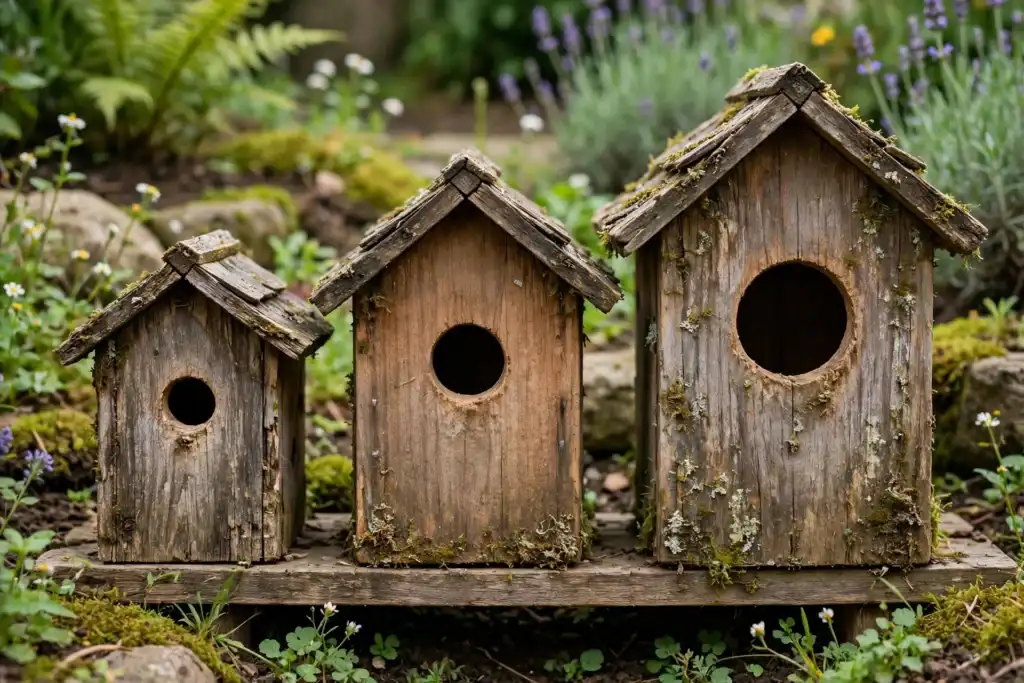
Birdhouse hole size at a glance
| Bird group | Typical visitors | Hole type | House notes |
|---|---|---|---|
| Small songbirds | Chickadees, wrens | Small round hole | Small house, small interior, near shrubs and cover |
| Medium cavity nesters | Bluebirds, tree swallows | Medium round hole | Larger house, roomier floor, open approach |
| Larger cavity nesters | Wood ducks and similar large birds | Large round or oval opening | Large house, strong support, species specific placement |
| Slot users | Some swallows and wrens in certain designs | Horizontal slot | Design specific, check a species guide before use |
Use this table as a starting point, not as a measurement chart. When two groups overlap, choose the smaller opening that still suits your target bird.
Round holes versus slot openings
Most bird boxes have a circular entrance hole, which most cavity nesting birds are happy with. As it resembles a natural tree hole entrance, it can also be easily protected with a circular metal plate.
Some bird boxes have rectangular entrance holes. This is useful for birds such as swallows as they can enter with a more flat body shape. However, if the entrance is too high then larger birds will enter the box. If they are too narrow then feathers can become trapped.
Do not change the entrance on round hole bird boxes to a rectangular entrance unless you have a guide for the species you are trying to attract that indicates a rectangular entrance is required.
It is best to put a round entrance hole for your first bird box. If you know that your target species prefer a rectangle hole in your area, then make sure you have a guide to show this.
Hole guards and predator protection
A hole guard is usually a metal plate. This stops chewing and hole enlargement. Squirrels and woodpeckers can easily enlarge wooden holes. A metal guard ensures this doesn’t happen.
Make sure that your hole guard is the right size and shape. There should be no sharp edges on the inside of the hole. If it is too big, you won’t be able to get in. If the hole guard has a rough edge it can damage the feathers. The hole guard should be secured so it cannot be pried off. Ensure that the screws are tightened each season.
Another way to keep your hole secure is by not having a perch. Many new owners are surprised to learn that cavity nesting birds do not need a perch. They will simply use their feet to grip onto the entrance and fly straight in.
Perches are very useful for predators. A cat, raccoon or large bird will be able to climb into the hole by standing on the perch. Do not provide a perch so that the nesting bird can use the hole rim.
Use smooth poles to keep it from getting raided. Place a baffle underneath the house and make sure there are no hanging branches. If you baffle your house it will be much harder to raid than if you just nail it onto a tree trunk.
Placement and height
Place the birdhouse where the target bird currently feeds, roosts and hides. If it is placed in an open area of your lawn with no bushes or trees nearby, it will feel very vulnerable and many cavity nesting birds will avoid it. If placed near some bushes, a small tree or hedge it will give the bird somewhere to hide within a short distance and places to perch and watch.
Try to position the entrance away from the prevailing winds and the harsh afternoon sun. If your entrance faces into a heavy rain shower, it will cause moisture to build up inside. If it is in full sun during the summer months, it will become too hot. Tilt your entrance slightly forward to help with keeping the inside dry. Try to position your entrance at different times of day to see where the shade will be during the hottest part of the day.
Although height can be overdone, the birdhouse should be high enough so that it is not easily reachable from the ground. However, there should still be some shelter nearby. It should also be low enough so that you are able to safely open, inspect and clean the birdhouse. Check your target birds species guide to find out the correct height range to aim for.
Do not put the birdhouse anywhere near windows. They can become very stressed and smash into the glass. For more information, please see our guide to why birds peck windows. If you are putting the birdhouse near your house try to avoid it. Putting it near some bushes with some flight space to somewhere to hide will make it much safer than facing a large reflective window.
Watch your birdhouse at the best time of day. This will help you see which birds are checking out your birdhouse, which are entering and which are being chased away. See our guide on when to watch birds for more information on when you will see the most activity around your feeders and yard. Often you will get great views of your birdhouse being visited in the morning.
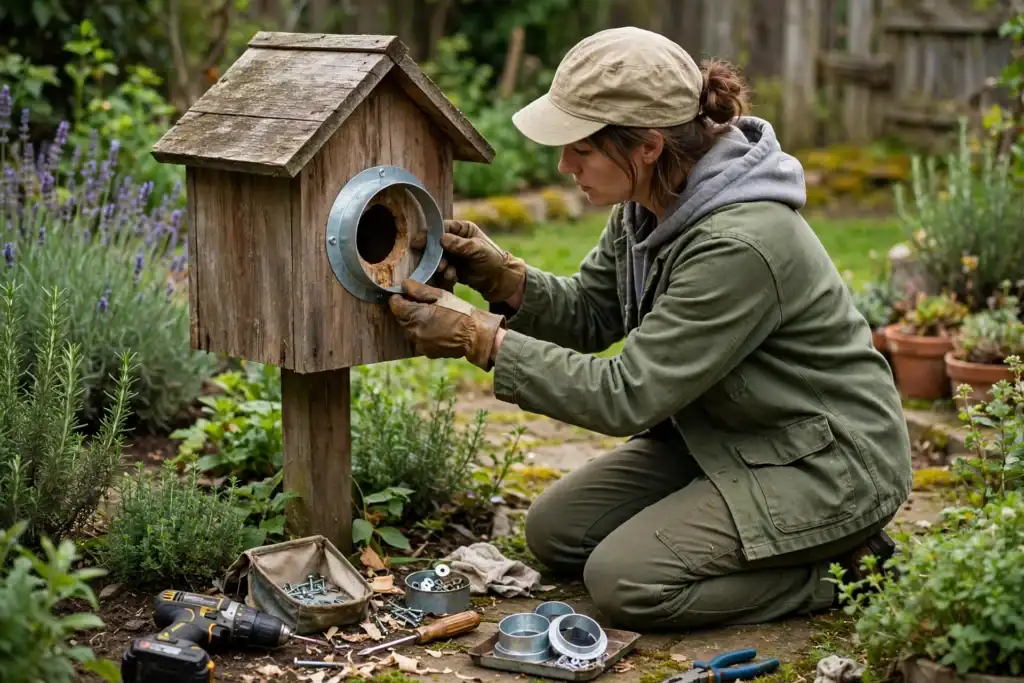
Cleaning and checking holes between seasons
Clean out your birdhouse and check the hole. Any old nests can cause issues with mites and dampness. Clear out any old items and make sure you clean with a brush so your birdhouse is ready to use again. Once everything is completely dry, you can put your birdhouse back together.
During your cleaning check the entrance hole for damage. This includes gnawing, enlargement, cracks and loose screws. If you have an enlarged entrance hole you will need to replace the guard or stop using the birdhouse for this species. If your entrance hole is smaller due to swelling or damage then you need to sand down the hole to prevent snagging on the feathers.
Check there is no damp or mold inside and that there are no holes allowing water and drafts in. If there is leakage from your birdhouse, then repair or replace it before next season.
While cleaning a birdhouse is a bit different to a feeder, the principle is the same. Make sure it is empty, brush out, and if possible, rinse. Ensure it is fully dry. For more information on cleaning bird feeders, please see our guide. You will notice that we have a schedule for cleaning our feeders. This should also apply to your birdhouse. Make sure to clean regularly and ensure it is dry before putting it back into use.
A step-by-step choosing and hanging workflow
Use this workflow in order, and finish one step before moving to the next. It works for a first birdhouse and for a replacement house.
- Decide which bird you want to attract. Note whether it is a small songbird, medium cavity-nesting bird or larger bird.
- Refer to a reliable species guide to see what hole size, chamber size and position are needed.
- Choose a house with the correct hole size, a metal guard, no perch, and an opening side or top for cleaning.
- Check that the hole has a smooth edge and that there are no splinters, sharp edges or rough holes.
- The house should be placed somewhere with good cover nearby, with a clear flight path, and away from prevailing wind, bright sunlight and large reflective windows.
- If possible, attach the house to a pole with a baffle, at a height you can safely check and clean.
- Ensure the entrance faces open space with some nearby cover. Do not face it towards a wall, fence or busy path.
- Monitor the house for a season and note which birds investigate, enter and whether any are driven away.
- Clean and check the hole between seasons, and repair the guard if necessary. Note if the hole has widened.
- Only change one thing at a time (position, height or guard) so that you know what has changed the outcome.
If a new bird appears at the house and you need help narrowing its identity, the Bird Finder can help compare candidates by size, shape, and behavior.
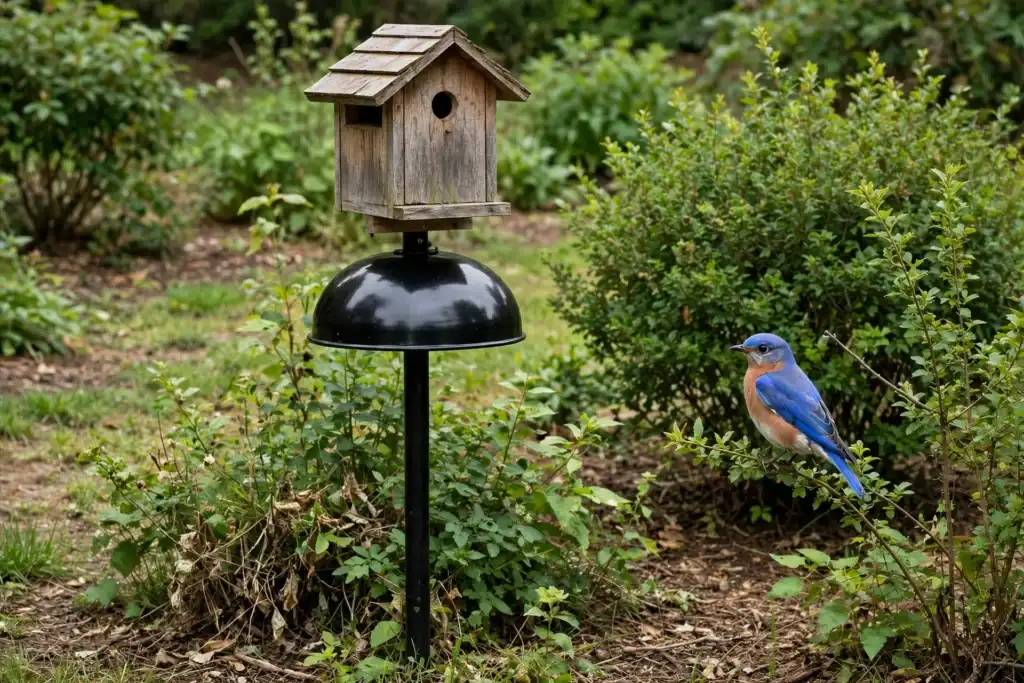
Common mistakes
The biggest mistake you can make is making the hole too large. While this seems generous it will attract bigger birds and predators. The main point of a birdhouse is to give shelter to just one bird. If you are unsure then go for the smaller hole, as long as it is still suitable for your desired species. Check your species guide.
Another common mistake is adding a perch. While it may look like it would help, cavity nesting birds do not need a perch. The predators will use it much more. Do not add a perch and let the nesting bird cling to the hole.
Another mistake is to paint the inside of your birdhouse. This can cause fumes and if the paint starts to flake off the birds can eat it. Leave the inside of the birdhouse natural.
Another mistake is to place your hole in an open area of lawn. The bird needs somewhere to hide a short distance from the hole, plus perches to watch from. If you put your birdhouse in the middle of an open patch of lawn, then it will feel very exposed, and many birds won’t want to come anywhere near it even if the hole is perfect.
Failure to clean can also be an issue. A dirty birdhouse with lots of old detritus, damp and mites can put off new residents. Clean between seasons, check the hole, and fix any issues with the guard.
Frequently asked questions
Can I enlarge a hole if no bird uses the house?
Firstly look at the location, cover, competition and season. This is often an issue with these houses being empty. If you increase the size of the hole you will be attracting a different species. Only do this if you know what you want to attract. Look up the species guide and add a guard for the new hole size.
Should a birdhouse have a perch?
No. They can climb into the cavity, so they do not need a perch. Perches are generally for predatory and larger birds. Don’t add a perch. Ensure that the edges of the entrance are smooth so that the bird can easily grip onto the hole.
How do I stop squirrels from enlarging the hole?
Use a metal baffle. Fit the house to a baffled pole. Avoid any branches that squirrels can jump from. Ensure the baffle is firmly attached each season as they can be pushed off. Often if there is no baffle on a wooden hole it will be enlarged.
Does hole size matter if I already have a guard?
Yes. But it won’t stop you making a mistake. If you use a hole that is too large then you will still get large birds through. Just use the right hole size and then fit a guard.
Can two birdhouses share the same hole size?
Yes they can. If they are targeting the same species/size and are separated they can decrease competition between pairs. It is harder to defend 2 houses of the same species. If they are different hole sizes and are separated they can target 2 separate groups in the same yard.
What if a bird I did not plan for moves in?
Leave them be. If you have a native bird and a safe house they are doing a good job. Removing nesting birds can cause problems. Find out what type of bird you have, look up their requirements in a species guide and add another house with the right hole size for your target bird next season.
Conclusion
The entrance hole is like a gate so it’s easy to control what birds can and can’t enter your birdhouse and how safe their nest will be. Small entrance holes are great for small songbirds such as chickadees and wrens. Medium entrance holes are perfect for bluebirds and swallows. Large entrance holes are perfect for larger cavity nesters. Round entrance holes are best for most back yard birds. Slot entrance holes are only suitable for specific designs. The entrance hole will stay the size you have chosen as there is a metal guard and no perch.
This is very simple to do. Choose a bird that you would like to attract. Check a reliable source for the hole size that they require. Choose a birdhouse with this hole size and a guard. Place this birdhouse somewhere with some shelter, but be sure it isn’t in any wind, harsh sun or reflective glass. Clean and check the hole between seasons. This means you have done a large job with a small measurement, and the correct bird will have a safe cavity to nest in each season.